Controversial oil refinery under consideration for possible Legacy Fund investment
BISMARCK, N.D. (North Dakota Monitor) — A long-stalled oil refinery proposed near Theodore Roosevelt National Park recently appeared on a short list of projects being considered for North Dakota Legacy Fund investment.
Meridian Energy Group first proposed the Davis Refinery for a site near Belfield in 2016. The company, by 2022, had weathered the pandemic, won a pair of lawsuits seeking to stop the project and acquired all the necessary permits. It informed state regulators construction would begin that year and operations would begin by the end of 2025.
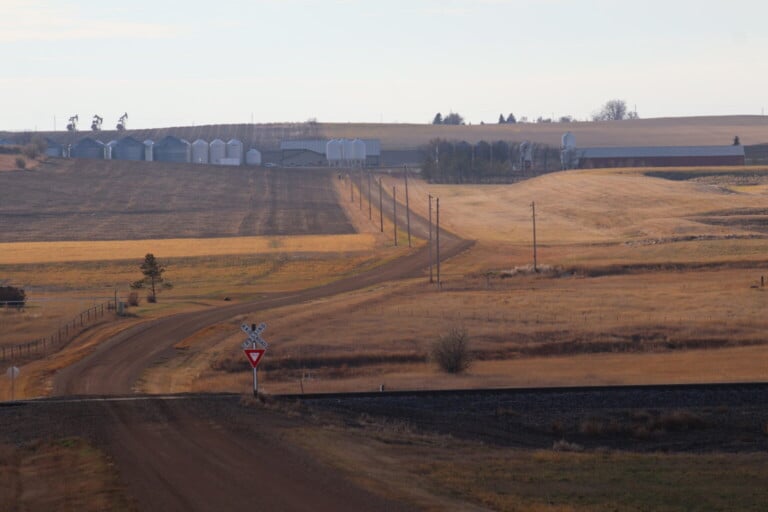
The site of the proposed refinery remains empty. No equipment is present and no sign of activity is visible.
Now a firm responsible for investing $150 million of the state’s Legacy Fund is considering an investment in the project. Voters created the fund, recently valued at more than $13 billion, to invest state oil and gas revenue and create a lasting revenue source for the state. Legislators have pushed to invest more of the fund in North Dakota.
GCM Grosvenor, a New York investment firm hired to manage the Legacy Fund’s investments in North Dakota projects, said in an Oct. 22 presentation to lawmakers it was considering a $10 million investment into the Meridian project.
“It’s a really interesting project, and they have raised money around it,” said Michael Rose, a managing director of infrastructure with the firm. “It’s just very early stage.”
Rose said the firm had met with Meridian Energy for about 10 hours and planned additional meetings to learn more about the opportunity.
Meridian CEO William Prentice said in an email the company plans to break ground on the estimated $1 billion facility in 2026. Its air quality and water use permits from two state agencies remain active despite years of inactivity.
Scott Skokos, executive director of the Dakota Resource Council that has opposed the Davis Refinery’s location 3 miles from Theodore Roosevelt National Park, said he thinks it would be a bad idea for the state to invest in the project that has spent a decade trying to raise the necessary funding.
“That’s enough to say this is a bad investment,” Skokos said. “They’re ignoring all the red flags.”
Prentice declined to specify how much money Meridian has raised to date. But he said the money raised, combined with funding arrangements with investment banks, is “more than adequate for the needs of the Davis project.” The company reported raising more than $35.6 million from 530 investors in filings to the U.S. Securities and Exchange Commission. Meridian’s last SEC filing was in 2022, records show. GCM Grosvenor told lawmakers the company has raised $75 million of the $1 billion project so far.
Ron Ness, president of the North Dakota Petroleum Council, said he hadn’t considered the possibility of using Legacy Fund dollars for the Davis Refinery.
“However, one of the goals of the Legacy Fund was to grow the N.D. economic base and diversify our economy,” Ness said in a statement. “Additional refining capacity in the state is a great value-add to our oil resources along with supporting rural economic development.”
‘Early review’
A possible investment into the Davis Refinery is in the “early review” stage for the firm handling the Legacy Fund’s infrastructure investments. Rose and Scott Litman, the two managing directors who briefed lawmakers, said they considered it an interesting opportunity but would wait until later in the project development process before committing any money.
State officials will not have a say in whether GCM Grosvenor invests $10 million in the project or not. GCM Grosvenor is given autonomy in evaluating investment opportunities and deciding whether to proceed in order to insulate the process from political influence, said Jodi Smith, executive director of the state Retirement and Investment Office that monitors the program.
A GCM spokesperson said the firm considers a broad range of factors when determining how to invest but declined to comment on specific projects under consideration, citing an internal policy.
“Every deal that goes through or that will ultimately come into this program will need to be approved by our investment committee,” Rose told lawmakers. “We’re not going to just take opportunities that come from anybody on this list and be like, ‘Well, OK, where do we sign?’ It’s got to go through our process.”
Rep. Keith Kempenich, R-Bowman, was one of the legislators present for the presentation. He represents the area the proposed refinery would be located in and supports the project. But the lawmaker said he would not be in favor of investing Legacy Fund dollars into a project like the Davis Refinery that is still looking for “seed money.”
“It’s up to the private industry to figure out where they want to go,” Kempenich said in an interview.
Project delays
Meridian has cited lawsuits, the COVID-19 pandemic and a lack of financing as reasons for delaying construction on the Davis Refinery. County records and court documents show the company has had trouble paying employees and contractors.
In 2019, engineering firm SEH filed a $2.1 million lien against the property that Meridian plans to construct the refinery on, according to Billings County records. SEH later filed a lien against the company with the North Dakota secretary of state as well. SEH has continued to complete work for Meridian in recent years, according to minutes of local government meetings.
In May 2020, Gibson Applied Technology and Engineering filed a lawsuit against Meridian seeking more than $400,000 for unpaid invoices. Later the same year, seven Meridian employees sued the company to obtain more than $600,000 in unpaid wages. Both lawsuits were filed in Texas and were resolved out of court.
In a court document from an unrelated lawsuit, also filed in Texas, a former Meridian employee said in a deposition that employees went without paychecks and were on public assistance in 2020 when the company wasn’t raising money.
Meridian began construction, by regulatory standards, in 2021 when it signed an engineering, procurement and construction contract with a new firm, McDermott International. But no significant on-site work was performed until years later, in 2023, when it approached Billings County for permission to improve local roads leading to the proposed refinery’s site.
Meridian has widened the roads and rebuilt them with gravel, said Billings County Highway Superintendent Pat Redmond. But he doesn’t know when Meridian will begin moving heavy construction materials to the site.
“I’ve been told numerous start dates but none of them have come true yet,” Redmond said.
Meridian has paid for the road work. Billings County required the company to provide a $1.8 million letter of credit before beginning the work, according to county commission minutes.
“We didn’t want to get stuck with a road half built,” said County Commissioner Steve Klym.

The site of the planned Davis Refinery near Belfield, North Dakota, is empty except for a crop planted to prevent erosion. (Photo by Jacob Orledge/North Dakota Monitor)
Prentice said in an email his company plans to complete the road improvements in spring 2026 and begin construction on the foundation of the refinery around the same time.
Meridian “decided to take a more measured approach during and immediately after COVID,” contributing to the project’s delays, Prentice said. The additional time has enabled Meridian to develop advancements with its design, he said. The company is negotiating a contract for an engineering firm to construct the facility and turn it over to Meridian ready to operate.
Prentice noted all litigation has been resolved but declined to comment further on the legal disputes. Prentice did not respond to questions about why employees were not being paid, the liens filed by SEH, critics’ concerns, and the unfulfilled timelines provided to Billings County.
Permits are active
North Dakota regulators first issued an air quality construction permit for the Davis Refinery in 2018 and a water use permit in 2019.
Air quality construction permits issued by the North Dakota Department of Environmental Quality typically expire within 18 months unless construction begins or an extension has been granted, Division of Air Quality Director Jim Semerad said in an email.
Regulators granted an initial 18-month extension due to lawsuits by environmental groups against Meridian that were resolved in 2020.
That extension was due to expire in 2021. But Meridian signed an engineering contract with McDermott International that year. Air quality regulators determined that was sufficient to consider the project under construction.
“The legal definition of start of construction in the air quality world has often been debated,” Semerad said in an interview. “It really is everything from signing contracts to actual construction that you’d notice as you’re driving by.”
Meridian also has to show construction progress in order for the air quality permit to remain in effect. The Department of Environmental Quality evaluates that on a case-by-case basis.
Semerad cited COVID-19 and tariffs as two prominent reasons why the Davis Refinery project has been slowed.
The water resource permit authorizes Meridian to draw water from the Dakota Aquifer. The Department of Water Resources has awarded extensions in 2022 and September 2025. The permit now expires in March 2029, but is unlikely to be extended again.
“By that time, more than ten years will have passed since permit approval, and further extensions are unlikely to be approved if water has not been put to beneficial use,” said John Paczkowski, state engineer, in a letter notifying the company of the latest extension.
Skokos said he believes Meridian is using technicalities to keep its environmental permits active.
“Every once in a while they’ll go do some dirt work, or they’ll sign a contract and make it appear like they’re doing something, and then they’ll put out a press release saying they did something, even though they didn’t really do anything,” Skokos said. “And then they keep looking for investors.”
The project promised to bring up to 200 new permanent jobs. But Klym, asked whether he thought the refinery would eventually get built after years of delays, demurred.
“No comment,” he said.
North Dakota Monitor reporter Jacob Orledge can be reached at jorledge@northdakotamonitor.com.