North Dakota’s delicate electricity price balance faces challenges
BISMARCK, N.D. (North Dakota News Cooperative) — As an energy exporter blessed with abundant supply, North Dakota consistently ranks among the cheapest states in the country when it comes to residential, commercial and industrial electricity rates.
Exploding costs of transmission, the buildout and replacement of transmission infrastructure and the increase in energy load have helped push residential electricity prices modestly higher in recent years, however.
Average residential per kilowatt-hour of power increased by nearly 30% in the state between 2020 and 2024.
A recent study by Lawrence Berkeley National Laboratory showed that North Dakota actually had the largest decrease in average retail industrial and commercial electricity prices in the country over that span, with flat or slightly lower rates for residential users, when adjusted for inflation.
Most of the real cost rise is due to the increased expense of transmission as well as materials, build outs, generation and transportation needed to keep up with energy demand and to replace aging systems.
Take transformers for example: they cost 70-100% more now than five years ago, according to International Energy Agency data. Aluminum and copper wiring is up to 50% more costly. Labor costs have also increased by around 20-40%.
“Four or five years ago, it was $400,000 a mile to build a transmission line. Now it’s $2 million a mile,” said Josh Kramer, executive vice president and general manager at North Dakota Association of Rural Electric Cooperatives. “Generation used to cost about $800 a kilowatt. Now it’s $2,700 a kilowatt.”
The cost of nearly every input into the energy transmission and maintenance system rose, on average, as much as 50%, he said.
State Sen. Dale Patten (R-Watford City) said replacement and upgrade costs of infrastructure are also one key component, particularly to improve resilience against severe weather events in rural areas.
“A lot of the existing infrastructure is old, 50, 60, 70 years old in some cases, and the cost of replacing it is not cheap,” said Patten, who chairs the legislature’s Energy and Natural Resources committee.
Population growth and shifts in that growth toward the main cities in the state are also a driver, he said.
“You have to build the infrastructure to support that population growth and that corresponding economic growth,” Patten said.
Another major driver is transmission costs.
“As we look at the regulated utilities when they come in for rate cases, it seems like one of the areas where their costs are exploding the most is transmission,” said Public Service Commission commissioner Randy Christmann. “Transmission costs are exploding.”
Christmann said some of the blame goes to buildout of remote renewables projects in the wider region, as well as the closure of coal fired power plants around the county leading to increased load on North Dakota power providers as regional transmission organizations spread costs around.
In 2024, North Dakota exported around 32% of generated electricity and exported 85% of natural gas extracted, according to the Department of Commerce.
Managing large loads
Adding large loads onto the grid across the country at the same time as all of these other cost increases has spiked energy prices in most other locations.
So far, North Dakota has dodged that for the most part, even as its lower electricity rates are attractive to industrial operations looking to add large loads in the system.
Large loads can include everything from operations like data centers, to oil refineries, to agricultural processing facilities and even the capital complex in Bismarck. Currently, there are 23 larger data centers in North Dakota.
When it comes to data centers, North Dakota has managed to add those large loads without jacking up electricity prices for consumers.
There are concerns about whether that can continue to be the case.
“I have seen them have very adverse impacts and very positive impacts,” said Christmann. “It depends on the details of the specific data center.”
Managing that going forward will be a challenge for the commission and legislators.
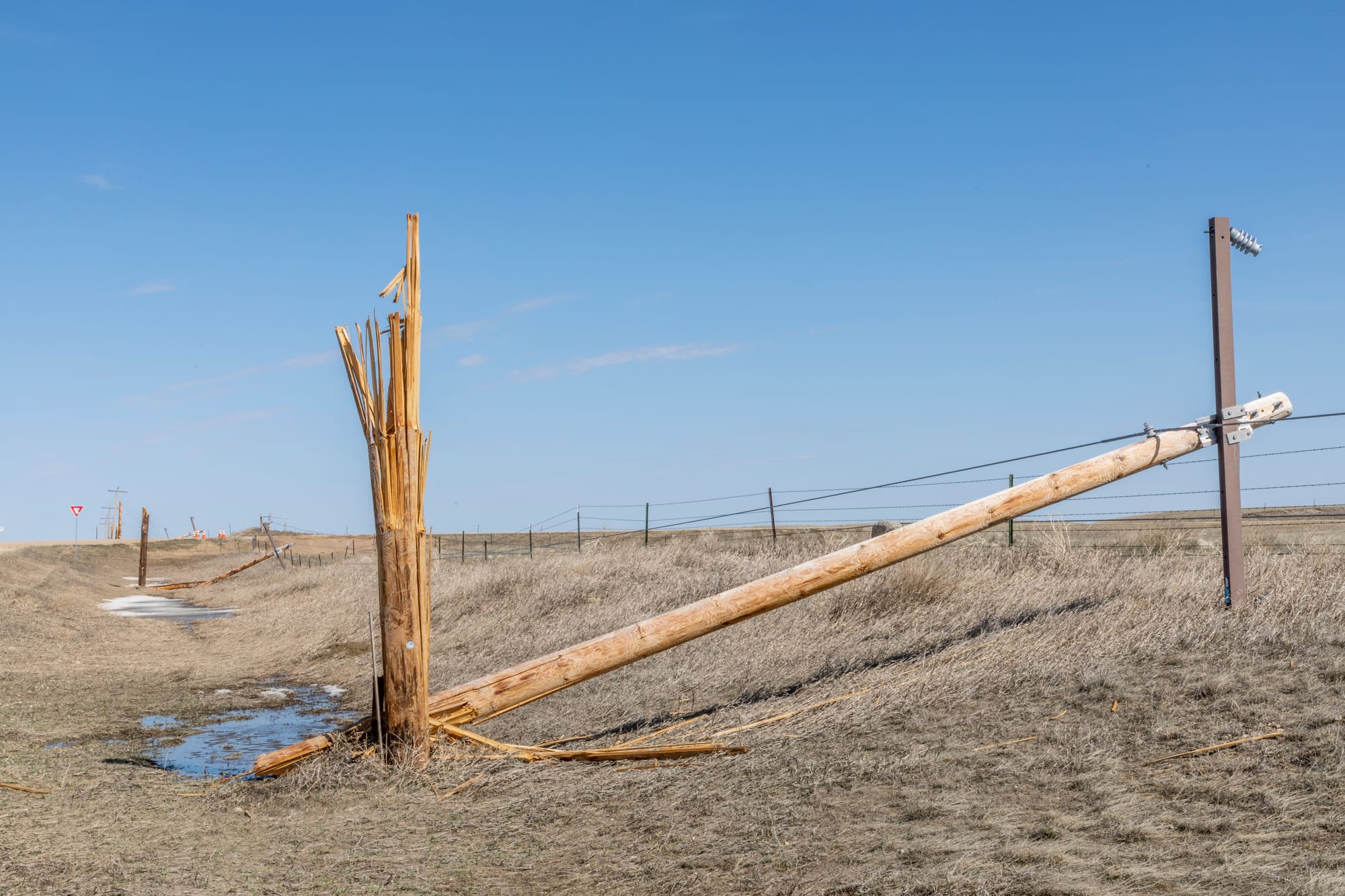
Rising costs and inflation also pressure electricity rates. Downed power lines and utility poles and associated equipment costs, on average 25-50% more now than just five years ago to replace. Photo provided by NDAREC.
State Rep. Anna Novak (R-Hazen) is currently leading the legislature’s interim Energy Development and Transmission Committee to study large loads such as data centers and try to find a way to balance attracting those projects without overburdening other electricity consumers.
“We need to strike a balance of making sure that we’re open for business, but that we have a strong vetting process,” Novak said. “I think that the vetting process is getting better.”
Besides cheaper electricity prices and available power, the policy and regulatory climate in the state is also attractive for tech companies looking to site a data center.
Data centers are also attracted to North Dakota’s readily available water supply and cooler temperatures, which cut operating costs.
Novak said cost savings for data centers choosing to locate here can amount to the billions.
“We are certainly a desirable place to put a data center,” Novak said.
The most well-known data center in the state, Applied Digital’s facilities near Ellendale, has become a case study for how to add a large load while keeping the local impact minimal and also providing benefits across the state.
By tapping into stranded power that was not being adequately used and making the capital investments on that instead of passing it to the utilities, the project has been able to actually decrease electricity rates for Montana-Dakota Utilities consumers across the state.
“We had involvement in that, in making sure that this big additional load was not only going to just not be detrimental to customers, but actually be very beneficial.” Christmann. “Every single MDU customer in North Dakota is benefiting because of that facility on their electric rate.”
Darcy Neigum, vice president of electric supply for Montana-Dakota Utilities, said that customers saved around $70 last year because of the facility, and once it is fully built out, savings could come out to around $250 per year per customer.
“We’re very aware of the rates we’re charging to our customers and the rate impacts,” Neigum said. “The approach that we took (with the Ellendale facility) was to try to find some way to create value instead of just putting costs on customers.”
Insulating consumers from costs
Investor-owned utilities like MDU as well as electric cooperatives like Basin Electric Power and Minnkota are all trying to figure out how to manage large loads going forward.
Basin Electric adopted a large load program in June as a way to minimize rate impacts for cooperative members and reduce the risk of stranded assets that come with single projects looking for 50, 100 or more megawatts of power in the future. Minnkota Power Cooperative has also adopted a similar policy.
“So, when we have those inquiries coming in, whether it’s a large tech company or a large industrial load, we’re saying we want to serve you, but to do that you’re going to have to bear the costs associated with it,” Kramer said. “That goes for if they need to add more infrastructure or generation or engineering studies.”
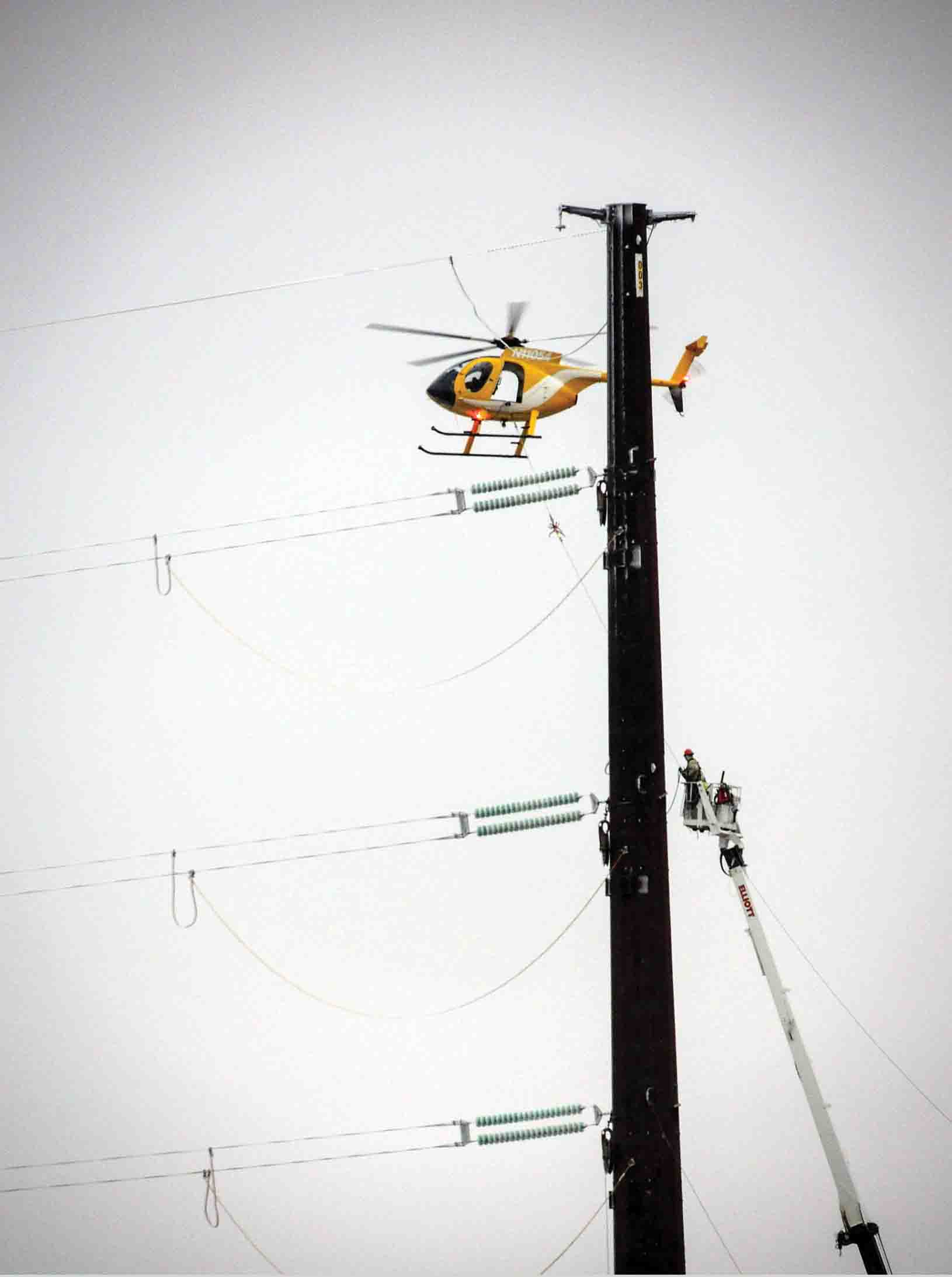
A small helicopter strings one of the lines on the last mile of the 163 mile BSSE transmission line connecting the Big Stone South Substation in South Dakota to the Ellendale Substation. The 345kv line, jointly owned and operated by Otter Tail Power Company and Montana-Dakota Utilities Company, was completed in late 2018, largely for the purpose of connecting wind generated power to Minnesota and points beyond. Photos by Ken Smith editor of the Dickey County Leader, December 3, 2018.
MDU’s Neigum said the company doesn’t have a formal policy yet, but the uptick in interest in adding large loads may necessitate one.
“We do have a process we go through, and we’re kind of formalizing some of that, because there are just so many requests,” Neigum said.
One delicate aspect in all of this is putting into place policies that protect consumers or co-op members from additional costs without scaring quality projects away from the state.
Kramer said that’s not necessarily a bad thing.
“It’s probably helped separate the wheat from the chaff a bit,” Kramer said.
(Story written by Michael Standaert, North Dakota News Cooperative)