Fargo Human Rights Commission members look for solution as city dissolves diversity efforts
FARGO — (North Dakota Monitor) North Dakota’s largest city is not sponsoring a Martin Luther King Jr. Day celebration this year and soon could be without a city-supported board that advises city leaders on promoting diversity and discouraging discrimination.
The Fargo City Commission voted 3-2 earlier this month to dissolve the Human Rights Commission in its current advisory role. City commissioners gave the board two months to come up with a plan to restructure in a way that taps fewer city resources, both financial and staffing.
Last week, the human rights group began discussing its options at a working session.
“The best thing we can do is come together so marginalized people in Fargo have a voice,” said Sekou Sirleaf, chairman of the advisory board.

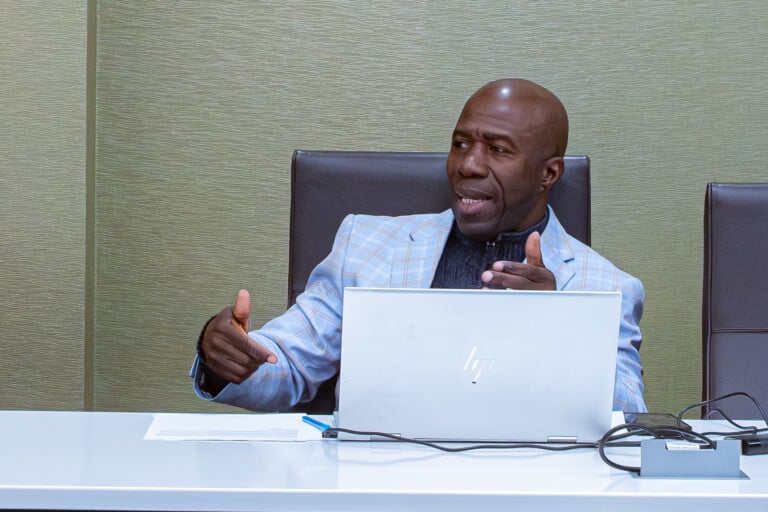
Fargo Human Rights Commission members Tambah Saah, left, and Xavier Welty discuss the group’s future at a meeting Jan. 15, 2026, at Fargo City Hall. (Photo by W. Scott Olsen/For the North Dakota Monitor)
But while much of the conversation focused on next steps, several members of the board and the public who attended the meeting voiced frustrations about recent actions of the City Commission.
“It’s a strong, horrible message from our city leaders,” said Barry Nelson, who among many other roles has served on the city’s Human Rights Commission in the past. “It shows where this city’s priorities are.”
Moving the commission to a community-based or nonprofit model could lessen its impact, said Nelson.
After the meeting, Sirleaf said the city of Fargo has a pattern of not supporting diverse, marginalized community members. The dismantling of the Human Rights Commission is the latest example, he said.
He observed that city commissioners voted on the board’s future less than a month after the Human Rights Commission accused city leaders of failing to support the Somali community when President Donald Trump made disparaging remarks about the immigrant group in neighboring Minnesota.
He pointed to the city commission’s decision to eliminate a three-year-old Diversity, Equity and Inclusion department in September 2024.
In addition, this year commissioners did not approve funds to sponsor community events that honor Martin Luther King Jr. Day and Juneteenth. Those costs were $17,886 and $12,500 respectively. Martin Luther King Jr. Day has been a longstanding event reaching back to at least 2002.
“Fargo is the most diverse city in North Dakota, but our city government and its decisions don’t reflect that,” Sirleaf said.
Fargo administrators referred a request for comment to the city’s spokesperson, who emailed a statement from Brenda Derrig, the assistant city administrator:
“While the City is no longer sponsoring MLK or Juneteenth events, the City continues to recognize the significance of both observances. On MLK Day and Juneteenth, community members are encouraged to take time to honor these observances, whether that is through service, learning or engagement within the community,” she wrote.
Derrig said funding was pulled because the city was prioritizing core services and evaluating how social services and arts funding is allocated.

Assistant Fargo Administrator Brenda Derrig, right, makes a point during the Fargo Human Rights Commission meeting Jan. 16, 2025, at Fargo City Hall. (Photo by W. Scott Olsen/For the North Dakota Monitor)
Fargo Mayor Tim Mahoney did not respond to an email requesting comment on the issue. Mahoney drafted a memo to the Fargo Commission for its Jan. 5 meeting saying that the city had spent the past year identifying ways to streamline the city’s volunteer boards and commissions, including the Human Rights Commission. The intent, he wrote, is that community members could continue these efforts “as independent community organizations without reliance on city staff or resources, but with continued city partnerships.”
The Fargo Human Relations Commission was founded in 2000 to promote acceptance and respect for diversity and discourage all forms of discrimination. In 2021, it was renamed the Human Rights Commission, according to the city website.
Fargo City Commissioner John Strand was among those who voted to disband the commission, but supported giving the group two months to come up with a different structure. He said there’s value in government hearing from diverse voices, but city advisory boards are limited by finances and governmental procedures. He said the board could be more effective if it doesn’t fall entirely under city jurisdiction.
He would like to see the Human Rights Commission morph into an entity that has appeal to the broader community.
“My hope is we can develop something that is connected to others in the state,” he said. “I would still like to see a city liaison appointed to the entity.”
Human rights commissions act as a local safeguard for civil rights and to promote inclusion. But these types of groups are not often established by local governments in North Dakota.
The Minot City Council discussed restoring a human relations committee in 2023, but ultimately voted to dissolve it, according to meeting minutes.
Grand Forks has not had a human rights committee associated with city government in the past two decades, according to John Bernstrom, the city’s public information officer.
Sargianna Wutzke is chair of the Bismarck Human Relations Committee. She said a couple years ago, a Bismarck city commissioner observed there wasn’t a place for community members to talk about important issues. In response, the committee started a quarterly forum on topics of importance.
Over the past year, the committee has hosted open conversations on issues like housing, accessibility and transportation. The format starts with presentations from experts and people with lived experience. Then the public is invited to share concerns and possible solutions.
A recent event on addressing homelessness drew a standing-room-only crowd, Wutzke said.
“We celebrate all the citizens and diverse populations we have here,” Wutzke said. “People want engagement on issues that matter.”

Dalton Erikson, from left, executive director of the North Dakota Human Rights Coalition, speaks alongside Barry Nelson, coalition founder, and Cody Schuler, advocacy manager at ACLU of North Dakota, during a meeting Jan. 15, 2026, at Fargo City Hall. (Photo by W. Scott Olsen/For the North Dakota Monitor)
Engagement is key to building connections and empathy that can lead to stronger communities, said Dalton Erickson, executive director of the North Dakota Human Rights Coalition, a statewide, member-based organization that has no direct connection to the Fargo group.
In a perfect world, local human rights groups would hold the local governments accountable, he said. They would ensure that all community members are heard and seen and able to exercise their human rights, he said.
“But local governments often don’t want to take on the tough civil rights issues like housing and accessible health care and federal over-reach,” Erickson said.
The loss of the Fargo Human Rights Commission should be concerning, Erickson said. But he’s also optimistic that a change after 25 years could provide some new ways of thinking and acting.
“They also could look at this as an opportunity to restructure and empower people,” Erickson said.