North Dakota town serves as an example of the promise and perils of data centers for South Dakota
ELLENDALE, N.D. — Don Flaherty worries about the future of the data center industry “every single day.”
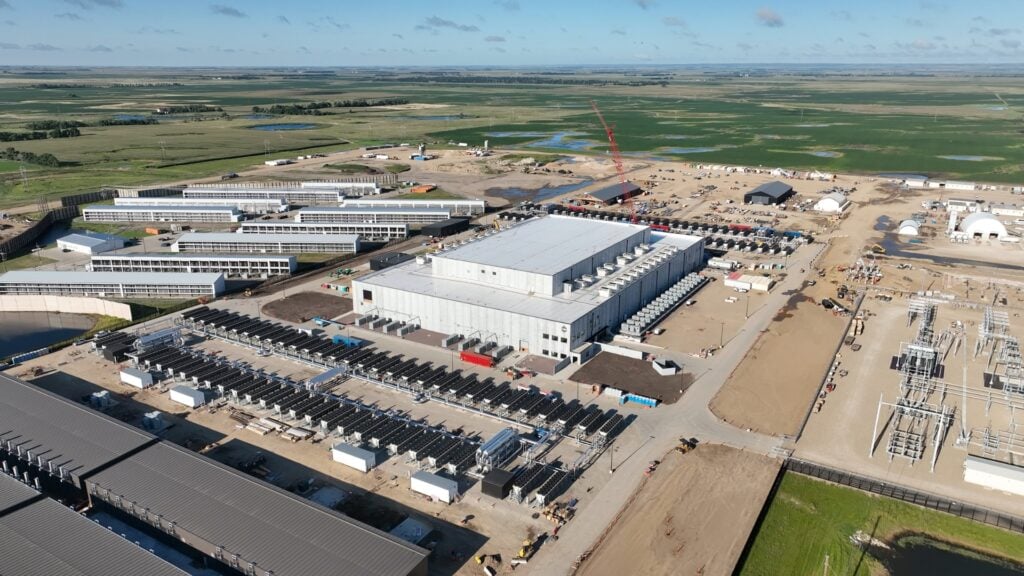
During his four years as mayor of Ellendale, North Dakota, the town has welcomed a growing data center campus from Dallas-based Applied Digital.
If the company goes belly up, so could the town.
“Could it blow up in my face?” Flaherty said. “Absolutely.”
For now, he said, “I have faith we’re on the right track.” He expects the city of about 1,100 people to grow by 500 or 700 residents in the next few years because of Applied Digital’s campus, which includes three data center facilities expected to create up to 350 jobs in Ellendale. The total cost to build the campus is about $5 billion.
Some data center boosters in South Dakota say Ellendale — which has more data center development than the entire state to its south — is an example to follow. But the data center boom has also brought challenges to the town, including rapidly rising housing costs.
Rooms or buildings full of computer servers have been storing cellphone pictures, emails, and social media accounts for years. What’s new are 100- to 1,000-acre warehouses full of servers for cryptocurrency and artificial intelligence. Those massive data centers with 30- to 1,000-megawatt loads have energy consumption equivalent to 29,000 to 800,000 South Dakota residential customers.
South Dakota’s biggest data center consumes 30 megawatts, and the state has none of the vastly larger data centers that have proliferated elsewhere. Some of South Dakota’s elected officials question whether the state should incentivize the industry as many other states have, due in part to the massive energy demands of large data centers and the potential impacts on the availability and cost of electricity for other customers.
Ellendale mayor: Benefits outweigh data center growing pains
Applied Digital approached Ellendale in 2021 because the town is near a substation collecting electricity generated by several wind farms in North and South Dakota.
The company’s first data center in Ellendale hired 35 people, a boon for a shrinking town, said Flaherty, whose son works at the facility.
Soon after, Applied Digital proposed expanding its operations. The two new facilities, once online, will increase the company’s demand in Ellendale to 530 megawatts.
A data center with a peak load of 530 megawatts operating at its maximum load near continuously would consume the same amount of energy as about 370,000 South Dakota residential customers, based on an estimate from South Dakota Public Utilities Commission Utility Analyst Darren Kearney.
North Dakota created a program to help finance 20 new homes in Ellendale, through a partnership with Applied Digital and a private developer. Other developers have purchased land for more homes in the area, anticipating demand.
Applied Digital, which volunteered to be annexed into Ellendale, “nearly doubles” the town’s tax base, Flaherty said.
Customers of Montana-Dakota Utilities, which is where Applied Digital purchases energy for its facilities, received credits on their energy bills due to data centers purchasing more energy from the grid and thereby increasing the utility’s revenue. Regulated utilities in North Dakota are required to provide the credits because of a return on equity cap set by the North Dakota Public Service Commission.
Those credits are called transmission riders and Fuel and Purchased Power Adjustment credits, which appear in the utility’s annual filings.
Electrical rates have stayed stable, there are no brownouts, and there is “more than enough power in our area to absorb what they’re taking,” Flaherty said.
North Dakota customers received $7.6 million in transmission rider credits in 2023, $9.8 million in 2024, and $7.4 million in 2025. North Dakota customers have received another $13 million in fuel and purchased power adjustment-related credits since 2023, according to a Montana-Dakota Utilities spokesperson.
The average Montana-Dakota Utilities customer saved about $70 in 2025.
South Dakotans served by MDU also received transmission rider credits because of data centers in MDU’s service area: $495,000 in 2024 and $619,000 in 2025.
South Dakota law does not mandate a return on equity cap like North Dakota, but the state Public Utilities Commission can call a company in for a general rate case “if it believes the company to be over-earning beyond the return authorized in the most recent rate case,” according to South Dakota PUC Public Utilities Manager Patrick Steffensen.
Nick Phillips, vice president of Applied Digital, said the company is operating at 312 megawatts of its anticipated 530-megawatt load in Ellendale. He expects Ellendale residents will receive more credit as data centers become fully operational.
“Because we’re located where the power is generated, we’re consuming power that wouldn’t have been consumed otherwise,” Phillips said. “We’re generating more revenue for the utility, causing us to pay parts of the transmission fees, costs and overhead fees.”
Mike Bockorny, CEO of the Economic Development Professionals Association of South Dakota and former CEO of the Aberdeen Development Corp., said Aberdeen reaps the benefit of Ellendale’s development. As the closest urban area to Ellendale, more than 1,000 construction workers are living temporarily in Aberdeen, impacting the region’s sales taxes, restaurant traffic and hotel stays.
Opportunity for some, problems for others
There are also construction workers living temporarily in Ellendale, said Jamie Walker, a former Ellendale resident. Walker was a property manager for an apartment complex in town until she moved away shortly after construction started on Applied Digital’s operation.
Walker now lives in Mayville, North Dakota, but her ex-husband lives in Ellendale and works at Applied Digital as a security guard. She visits the town to pick up and drop off her children.
Walker said demand for housing from construction workers doubled the monthly rental rate of a one-bedroom apartment at the complex where she worked from around $600 to more than $1,200. The increase has made housing unaffordable for lower-income residents, she said, pointing to families who moved out of Ellendale because of the increases in rent.The construction is “good money for the town,” she said, but she worries about the long-term damage of dozens of families with children leaving Ellendale because of unaffordable housing prices.
“The regular Ellendale local is not winning as big as, say, Casey’s or Cenex or the local bars,” Walker said, referring to a pair of local gas stations. “The money from this is going to be very short-term and one-sided.”
Most Ellendale residents, Flaherty said, are apathetic about Applied Digital. Others are supportive like him, and some have been critical. Concerns include traffic from increased construction workers, fears of increased crime, and worries of less day care access in the future due to the expected population increase.
Flaherty said a local business purchased a building to refurbish as a day care, traffic concerns are temporary, and there have not been any “unusual spikes” in crime.
The first data center, which is air-cooled, emits an audible hum on the edge of town or within a mile of the facility, Flaherty said. The second and third data centers will be water-cooled in a closed loop system, which is supposed to make them quieter and will not strain the local water supply as other data centers across the country have. Phillips said the closed loop system will use about one household’s worth of water.
Flaherty said the town has had to handle an influx of other issues — ordinances for mobile home parks, peddlers and food trucks — but that “all of it is worth it, even in the short term.”
“Even though some things are a headache, I can see how they’ll benefit our community ultimately,” Flaherty said. “The growth will help us survive so we’ll be a thriving community well into the next century.”
Data centers eyed for Deuel County, Sioux Falls, Madison
Applied Digital is attempting to build its first South Dakota location in Deuel County, near the small town of Toronto on the far eastern side of the state. The company believes South Dakota is a prime location for data centers because of its wind energy, its abundance of electrical power, and the potential for its cool climate to help data centers save on cooling costs.
The up to 430-megawatt, two-building Deuel County proposal is near Otter Tail Power’s transmission lines and a natural gas-fired generation plant in Astoria. The location is also surrounded by farm ground, which could allow for future expansions.
Phillips said the company wants to expand to South Dakota so its data centers are spread across a wider footprint, creating less risk to operations. He expects the data center would employ 250 people in the county of roughly 4,300.
The Toronto project could generate over $10 million per year in state sales taxes on its electrical service, according to Applied Digital. The project could also result in a total of $5.5 million in property taxes annually for Deuel County and Deubrook School District. Phillips said the state would bring in about another $19 million in one-time sales taxes associated with site development and construction.
Applied Digital’s proposed site is about 35 miles from where Republican South Dakota Rep. Kent Roe lives. He said there’s a mix of support, opposition and skepticism among his constituents.
While artificial intelligence-led investments are driving the country’s recent economic growth, the industry faces challenges with other technological advancements, such as quantum computing, which could revolutionize the way data is processed and stored, and potential supply chain disruptions due to more complex microchips and equipment with each upgrade.
Roe is confident that data centers will be valuable to their communities for at least the next few decades, given the level of investment needed and the decades-long contracts signed with energy companies. He’s proposing state legislation that would make data center purchases of equipment and software exempt from state and local sales taxes.
“They’re not going to roll into Deuel County, invest $5 billion and walk away in three or four years,” Roe said, adding, “I think we need to pull the future to us.”
Roe can recall a time when Toronto intentionally burned down vacant houses due to population decline.
“It’s a pathway out of this stasis that we’re in right now,” Roe said.
Phillips said Applied Digital is working with local leaders to potentially build apartment complexes for construction workers in Toronto and transition them to senior housing when construction workers leave. The town does not have a senior living facility for its aging residents.
“Construction workers and seniors kind of need the same thing: relatively small living quarters with community spaces,” Phillips said. “Perhaps there’s a way for us and the county to work together to build housing upfront for construction, with all of the costs being borne by Applied Digital, and then turn that into a benefit for the community.”
Although Applied Digital is proposing building in Deuel County, the company has not started the permitting or zoning process, nor has it bought land for the roughly $5 billion project. Phillips said the company is waiting to close on the land until the Legislature passes a data center sales tax exemption law.
Other South Dakota communities are also taking actions that could aid data center development. The Madison City Commission greenlit an incentive program for data centers in November with Heartland Energy, hoping to attract cryptocurrency operations to the city by providing discounted energy rates, according to the Madison Daily Leader.
Los Angeles-based real estate company Gemini Capital hopes to develop a 500-megawatt, $1.9 billion facility, powered by Xcel Energy, in eastern Sioux Falls. The Sioux Falls City Council rezoned the property recently. Opponents tried unsuccessfully to petition the decision to a citywide referendum election.
The Lincoln County Commission will hold a public hearing on a proposed data center moratorium on Feb. 24. State law would cap any adopted moratorium at one year unless renewed, and it would only apply to Lincoln County’s unincorporated areas.
At least one large data center is already operating in South Dakota: a 30 megawatt facility near Onida. The project is planned to expand to 300 megawatts in the next few years, according to owner Big Watt Digital.
This story was originally produced by South Dakota Searchlight, which is part of States Newsroom, a nonprofit news network which includes North Dakota Monitor, and is supported by grants and a coalition of donors as a 501c(3) public charity.