Actor Robert Duvall dead at 95
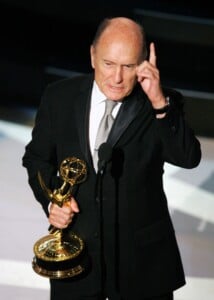
LOS ANGELES (AP) — Robert Duvall, the Oscar-winning actor of matchless versatility and dedication whose classic roles included the intrepid consigliere of the first two “Godfather” movies and the over-the-hill country music singer in “Tender Mercies,” has died at age 95.
Duvall died “peacefully” at his home Sunday in Middleburg, Virginia, according to an announcement from his publicist and from a statement posted on his Facebook page by his wife, Luciana Duvall.
“To the world, he was an Academy Award-winning actor, a director, a storyteller. To me, he was simply everything,” Luciana Duvall wrote. “His passion for his craft was matched only by his deep love for characters, a great meal, and holding court. For each of his many roles, Bob gave everything to his characters and to the truth of the human spirit they represented.”
The bald, wiry Duvall didn’t have leading man looks, but few “character actors” enjoyed such a long, rewarding and unpredictable career, in leading and supporting roles, from an itinerant preacher to Josef Stalin. Beginning with his 1962 film debut as Boo Radley, the reclusive neighbor in “To Kill a Mockingbird,” Duvall created a gallery of unforgettable portrayals. They earned him seven Academy Award nominations and the best actor prize for “Tender Mercies,” which came out in 1983. He also won four Golden Globes, including one for playing the philosophical cattle-drive boss in the 1989 miniseries “Lonesome Dove,” a role he often cited as his favorite.
In 2005, Duvall was awarded a National Medal of Arts.
He had been acting for some 20 years when “The Godfather,” released in 1972, established him as one of the most in-demand performers of Hollywood. He had made a previous film, “The Rain People,” with Francis Coppola, and the director chose him to play Tom Hagen in the mafia epic that featured Al Pacino and Marlon Brando among others. Duvall was a master of subtlety as an Irishman among Italians, rarely at the center of a scene, but often listening and advising in the background, an irreplaceable thread through the saga of the Corleone crime family.
“Stars and Italians alike depend on his efficiency, his tidying up around their grand gestures, his being the perfect shortstop on a team of personality sluggers,” wrote the critic David Thomson. “Was there ever a role better designed for its actor than that of Tom Hagen in both parts of ‘The Godfather?’”
In another Coppola film, “Apocalypse Now,” Duvall was wildly out front, the embodiment of deranged masculinity as Lieutenant Colonel Bill Kilgore, who with equal vigor enjoyed surfing and bombing raids on the Viet Cong. Duvall required few takes for one of the most famous passages in movie history, barked out on the battlefield by a bare-chested, cavalry-hatted Kilgore: “I love the smell of napalm in the morning. You know, one time we had a hill bombed, for 12 hours. When it was all over, I walked up. We didn’t find one of ‘em, not one stinkin’ dink body.
“The smell, you know that gasoline smell, the whole hill. Smelled like — victory.”
Coppola once commented about Duvall: “Actors click into character at different times — the first week, third week. Bobby’s hot after one or two takes.”
He was Oscar-nominated as supporting actor for “The Godfather” and “Apocalypse Now,” but a dispute over money led him to turn down the third Godfather epic, a loss deeply felt by critics, fans and “Godfather” colleagues. Duvall would complain publicly about being offered less than his co-stars.
Fellow actors marveled at Duvall’s studious research and planning, and his coiled energy. Michael Caine, who co-starred with him in the 2003 “Secondhand Lions,” once told The Associated Press: “Before a big scene, Bobby just sits there, absolutely quiet; you know when not to talk to him.” Anyone who disturbed him would suffer the well-known Duvall temper, famously on display during the filming of the John Wayne Western “True Grit,” when Duvall seethed at director Henry Hathaway’s advice to “tense up” before a scene.
Duvall was awarded an Oscar in 1984 for his leading role as the troubled singer and songwriter Mac Sledge in “Tender Mercies,” a prize he accepted while clad in a cowboy tuxedo with Western tie. In 1998, he was nominated for best actor in “The Apostle,” a drama about a wayward Southern evangelist which he wrote, directed, starred in, produced and largely financed. With customary thoroughness, he visited dozens of country churches and spent 12 years writing the script and trying to get it made.
Among other notable roles: the outlaw gang leader who gets ambushed by John Wayne in “True Grit”; Jesse James in “The Great Northfield Minnesota Raid”; the pious and beleaguered Frank Burns in “M-A-S-H”; the TV hatchet man in “Network”; Dr. Watson in “The Seven-Per-Cent Solution”; and the sadistic father in “The Great Santini.”
“When I was doing ‘Colors’ in 1988 with Sean Penn, someone asked me how I do it all these years, keep it fresh. Well, if you don’t overwork, have some hobbies, you can do it and stay hungry even if you’re not really hungry,” Duvall told The Associated Press in 1990.
In his mid-80s, he received a supporting Oscar nomination as the title character of the 2014 release “The Judge,” in which he is accused of causing a death in a hit-and-run accident. More recent films included “Widows” and “12 Mighty Orphans.”
Robert Selden Duvall grew up in the Navy towns of Annapolis and the San Diego area, where he was born in 1931. He spent time in other cities as his father, who rose to be an admiral, was assigned to various duties.
The boy’s experience helped in his adult profession as he learned the nuances of regional speech and observed the psyche of military men, which he would portray in several films.
Duvall reportedly used his Navy officer father as the basis for his portrayal of the explosive militarist in “The Great Santini,” based on the Pat Conroy novel. He commented in 2003: “My dad was a gentleman but a seether, a stern, blustery guy, and away a lot of the time.” Bobby took after his mother, an amateur actress, in playing a guitar and performing. He was a wrestler like his father and enjoyed besting kids older than himself.
He lacked the concentration for schoolwork and nearly flunked out of Principia College in Elsah, Illinois. His despairing parents decided he needed something to keep him in college so he wouldn’t be drafted for the Korean War. “They recommended acting as an expedient thing to get through,” he recalled. “I’m glad they did.” He flourished in drama classes.
“Way back when I was in college,” Duvall told the AP in 1990, “there was a wonderful man named Frank Parker, who had been a dancer in World War I. We did a full-length mime play and I played a Harlequin clown. I really liked that.
“Then, I played an older guy in ‘All My Sons,’ and at one point I had this emotional moment, where this emotion was pouring out. Parker said at that moment he didn’t think acting can be carried any further than that. And this guy was a very critical guy. So I thought, at that moment at least, this is what I wanted to do.”
After two years in the Army, he used the G.I. Bill to finance his studies at the Neighborhood Playhouse in New York, hanging out with such other young hopefuls as Robert Morse, Gene Hackman and Dustin Hoffman. After a one-night performance in “A View From the Bridge,” Duvall began getting offers for work in TV series, among them “The Naked City” and “The Defenders.”
Between his high-paying jobs in major productions, Duvall devoted himself to directing personal projects: a documentary about a prairie family, “We’re Not the Jet Set”; a film about gypsies, “Angelo, My Love”; and “Assassination Tango,” in which he also starred.
Duvall had been a tango dancer since seeing the musical “Tango Argentina” in the 1980s and visited in Argentina dozens of times to study the dance and the culture. The result was the 2003 release about a hit man with a passion for tango.
His co-star was Luciana Pedraza, 42 years his junior, whom he married in 2005. Duvall’s three previous marriages — to Barbara Benjamin, Gail Youngs and Sharon Brophy — ended in divorce.