North Dakota cities hunt for hazardous lead water pipes
MANDAN, N.D. (North Dakota Monitor) — North Dakota’s public water systems have spent several years creating vast inventories of their service lines in an effort to find pipes made of lead, which pose a health threat. Now, communities are beginning to use that information to replace both public and private lines.
Municipal and rural water systems across the country began mapping their service lines — pipes connecting buildings to water mains — after the U.S. Environmental Protection Agency required them to begin that process in 2021.
Most of the nation’s lead and galvanized lines are concentrated in the older cities of the eastern United States, which were built before lead pipes were banned.
North Dakota is estimated to have fewer than 20,000 lead and galvanized lines, while neighboring Minnesota is estimated to have between 40,000 and 150,000, according to the EPA.
According to the Centers for Disease Control and Prevention, lead exposure can impact nearly every organ and bodily system.
Children are particularly vulnerable, as their intelligence, behavior and ability to learn can be impacted even at low levels of exposure. Lead has also been classified as a probable human carcinogen by the EPA.
The EPA implemented its first Lead and Copper Rule in 1991, requiring water systems to test their water for lead and copper and take action if results exceeded safe levels.
The 2021 Lead and Copper Rule Revisions added requirements to inventory all of a system’s lines and their materials. Water systems had until October 2024 to submit a preliminary inventory to state regulators.
While all systems in North Dakota have complied, many had “unknown” lines in their 2024 inventories and have since been working to inspect those pipes, according to Sandra Washek, who manages the Lead and Copper Rule for the North Dakota Department of Environmental Quality.
Some have also begun replacements. That comes ahead of a new EPA rule, the Lead and Copper Rule Improvements, which will go into effect in November 2027 and require cities to begin replacing their lines. They’ll have until 2037 to complete that process.
Lines need to be replaced if they are made of lead or if they are made from galvanized steel and are downstream from lead lines, because galvanized steel can capture lead from passing water and release it later.
Service lines include a public section — typically from the water main to the “curb stop” at the edge of a property — and a private section that runs from the curb stop to the building.
Both sides have to be inventoried. To help communities do that, the 2021 Bipartisan Infrastructure Law earmarked funding for states to disperse to local water systems.
The North Dakota Drinking Water State Revolving Fund, a low-interest loan program that helps communities finance water infrastructure projects, has received close to $30 million in federal funding every year from 2022 to 2026 to support lead service line work.
Of North Dakota’s more than 300 water systems, around two-thirds are using that money to help cover their costs, according to Shannon Fisher, who manages the fund.
While water systems are only required by the EPA to replace the public section of lead lines, water systems must offer to replace any private lead lines they find to qualify for a state loan, Fisher said.
However, in other communities, cities may split the cost with property owners, or residents may have to pay the full cost out of pocket.
The state has also used part of its federal funding to hire engineering firms to help water systems complete their inventories, Fisher said.
Advanced Engineering and Environmental Services, or AE2S, is one of those firms. It’s working with more than 30 water systems across North Dakota.
It helped cities put together their initial inventories by reviewing municipal records and identifying neighborhoods built after North Dakota banned lead in water systems in 1989.
“Any structure that was built after that, if we could identify it on our maps, we could eliminate it,” said Eric Lothspeich, an AE2S project manager working in Mandan.
That delineation has helped North Dakota’s newer cities narrow down their search. In West Fargo, all five of the lead service lines found so far were in an old neighborhood called Riverside, said Brian Matzke, the city’s public works director.
The small number of lead lines meant West Fargo was able to cover the cost of replacing those lines — on both the public and private sides — out of its own budget.
West Fargo still has around 800 unknown lines, but Matzke said he doesn’t expect to find more lead.
“We got lucky — Bismarck, Fargo and Mandan, some of those … they ain’t good,” Matzke said. “They’ve got a headache coming their way.”
As of March, Mandan has identified 65% of its 7,900 service lines, including 89 lead lines and 17 galvanized lines that need to be replaced, Lothspeich said. Another 2,770 are still “unknown.”
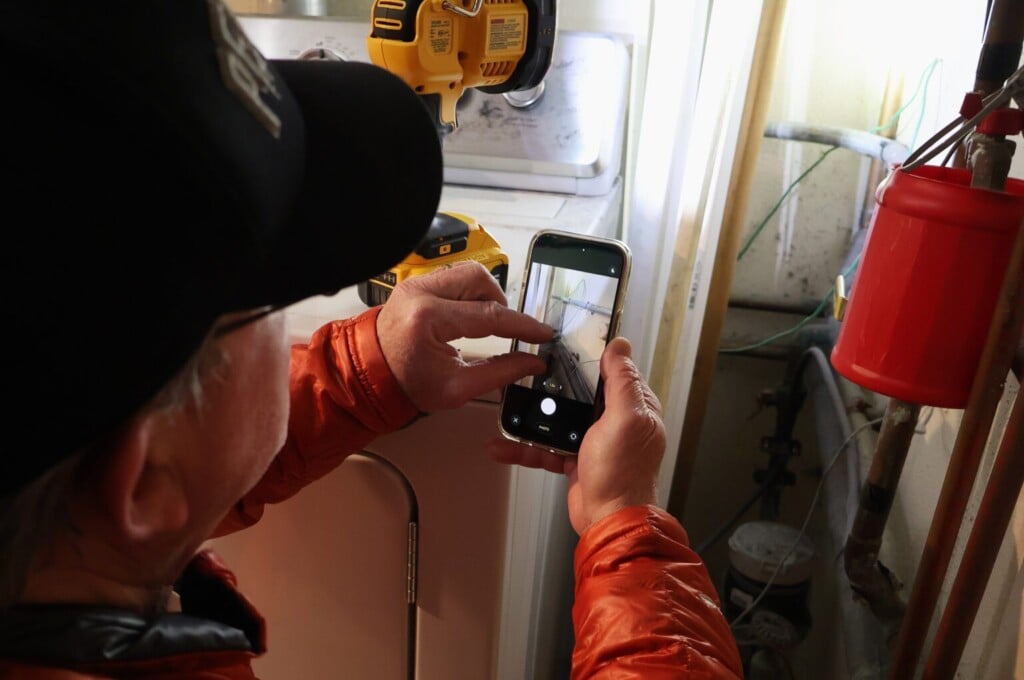
This year, AE2S will work to bring that number down by knocking on doors and sending out surveys to ask property owners to test their line themselves or set up a time for an inspector to test it for them.
As inspections continue, Lothspeich said he expects to find “somewhere between 200 and 250” lead and galvanized lines in total.
Mandan will also begin replacing lines this summer using a loan from the revolving fund, two-thirds of which will be forgiven. The city will use that money to replace all of the lead and galvanized lines, including sections on private property.
How much the city will ultimately have to pay will depend on the number of lines found, the number of contractors available and how difficult it is to access pipes, Lothspeich said, adding that replacing a line can cost around $8,000 to $12,000.
“I wouldn’t want to tell somebody that that’s what it’s going to cost, ’cause it’s hard to know for sure,” he said. “But if you just do the math … if you say it’s $10,000 per service line and you have 200 of them, you’re looking at about $2 million.”
In communities that don’t cover the cost themselves, what property owners may have to pay to replace their part of a line will vary, Lothspeich said.
That’s because what communities consider to be the “private” section can sometimes be more than half of the line, and because individual factors — like whether asphalt or dirt has to be excavated — impact cost, he said.
Washek, from the Department of Environmental Quality, urged property owners to reach out to their water provider and get their lines tested.
“The more we get all these lines identified on both sides, the faster we can get the systems to move onto the next step,” she said.
While waiting for a line to be inspected or replaced, Washek said residents can reduce exposure by flushing their lines in the morning, cleaning their aerators, using cold water to cook, using filters approved for removing lead, and having their blood lead levels tested by a doctor.
(Story written by Ceilidh Kern – North Dakota Monitor)