Lawsuit contends North Dakota utilities, regulators mishandled powerline case
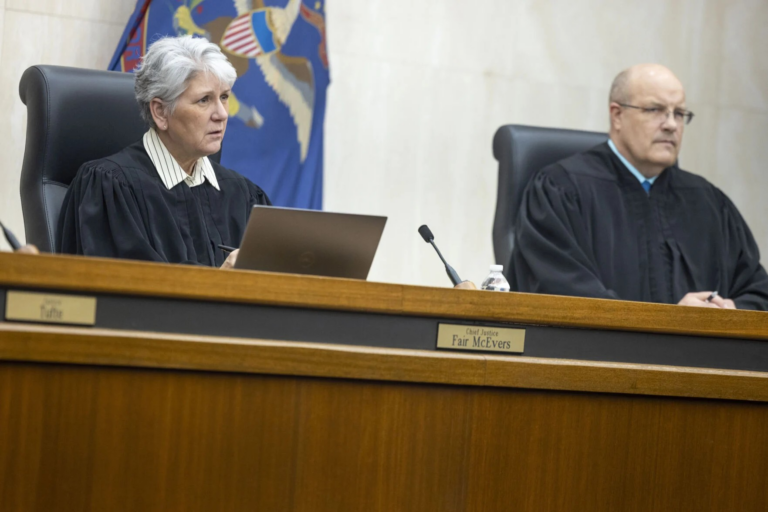
BISMARCK, N.D. (North Dakota Monitor) — With a decision on a controversial powerline pending with North Dakota utility regulators, the state Supreme Court is considering an appeal from residents and local governments along the project’s path who say they were shut out of the permitting process.
The Jamestown to Ellendale high-voltage transmission line, also known as JETx, would use towers up to 150 feet tall in a path about 90 miles long in Dickey, LaMoure and Stutsman counties in south-central North Dakota.
The North Dakota Public Service Commission needs to approve the final route, but a lawsuit is appealing a previous PSC decision that said the powerline is a needed addition to the electrical grid.
The lawsuit was brought by township governments and landowners along the JETx route. The opponents argue that the project developers, Otter Tail Power and Montana-Dakota Utilities, were allowed to file for a certificate of public convenience and necessity under the wrong state statute. The utilities say they were conducting business as usual.
Attorney Doug Nill, representing the townships and landowners, has requested oral arguments in the case. No hearings have been scheduled. The next round of briefs to be filed in the case is due at the end of April.
The lawsuit says that had the certificate been sought correctly, it would have triggered direct notification of townships along the route and hearings where local officials and residents could have provided input.
As the project developers moved on to the next step — getting a route permit from the PSC — Nill said they switched the proceedings to the section of law that should have been used in the first place.
With the question of need already decided, that stifled debate during public hearings on the powerline route, Nill said.
“They’re saying ‘public need has already been determined. We’re not going to let you talk about public need,’” Nill said.
In court documents, attorneys for Otter Tail Power and Montana-Dakota Utilities, with Paul Forster of Bismarck as the lead attorney, said the application process used on the JETx line is the norm and cited other applications that used the same process.
“This two-step permitting process is not a novel approach, much less a nefarious scheme to cut corners,” the utility attorneys argued.
Forster did not respond to an email request for comment.
Township officials tried to bring up whether the powerline was really needed during the PSC siting hearings held in January in Ellendale, Edgeley and Jamestown.
But administrative law judge Hope Hogan, who oversaw the hearings, agreed with Otter Tail’s objections that such testimony was outside the scope of the hearings. Hogan rejected the request of townships to accept written testimony in an order on March 13.
The case before the North Dakota Supreme Court is Wano Township v. the North Dakota Public Service Commission. Along with Wano Township in LaMoure County are four other townships, multiple landowners and farm partnerships and the Willowbank Hutterian Brethren Association. Named as defendants along with the PSC are Otter Tail Power and Montana-Dakota Utilities.
The lawsuit contends that instead of filing for a certificate of need under the statute covering new powerlines, the companies filed under the state’s Territorial Integrity Act “directed to service territory and line extension disputes between electric providers,” the opponents say in court documents.
That act requires only a notice in the local newspaper — not direct notification in writing to township officials. Because they were not notified, the township officials say they did not intervene in the certificate of need process.
The PSC approved that certificate in November 2024. Commission Chair Randy Christmann voted against the project, citing the expense that would have to be passed on to ratepayers.
The townships and residents appealed the decision, but in June 2025, the PSC ruled the appeal came too late.
Appeals to the PSC and Burleigh County District Court have been denied, leaving the Supreme Court as their last hope.
A key part of the dispute is determining when the clock started ticking on an appeal by the townships.
The PSC and attorneys for the utilities contend the clock started after the commissioners approved the certificate of need.
Nill and the townships say they weren’t even aware the PSC was considering that action until the PSC voted. They argue the clock still hasn’t started on a deadline for an appeal because that vote was invalid.
Attorneys for the utilities say the state law used to file for the certificate of public convenience goes beyond turf and service disputes.
The first section of the law says such a certificate is required before a utility can begin construction on a power plant or system.
The district court judge sided with the PSC on the timeline issue. But Nill is hopeful that the Supreme Court will rule on what he considers the heart of the matter — that Otter Tail Power and Montana Dakota Utilities filed their application for a new powerline under the wrong section of state law.
The powerline is controversial for a couple of reasons — some see it as serving data centers at Ellendale and Jamestown and some see it as facilitating Minnesota’s need for green energy from North Dakota wind farms.
Those along the more than 90-mile route will have to put up with 150-foot towers that some say are ugly. Some say the towers and high-voltage lines make it harder to farm and aerial spray fields.
The JETx project featured prominently in the discussion of House Bill 1258, which gave the PSC zoning authority on large powerlines, trumping local ordinances. The bill means that utility companies can build as close as 500 feet from a residence. Some townships had tried to keep it as much as a half-mile from residences.
During a PSC on the JETx project Tim Leppert of Russell Township in LaMoure County blasted the new law.
Leppert said the law gives utilities “the power to bulldoze through townships.”
Otter Tail Power and Montana-Dakota Utilities said during the hearings that the half-mile setbacks are unreasonable and asked the PSC to invoke the new law.
The main sponsor of the bill was Rep. Mike Brandenburg, R-Edgeley, who represents people affected by the powerline project. He has blamed out-of-state influence for some of the opposition to a project he said benefits local residents.
Reach North Dakota Monitor deputy editor Jeff Beach at jbeach@northdakotamonitor.com