In the car with the Minneapolis community patrols working to disrupt ICE operations
MINNEAPOLIS, Minn. (Minnesota Reformer) — As Elle Neubauer drove before dawn past the darkened windows of the immigrant-owned businesses on Lake Street in Minneapolis, her co-pilot and friend Patty O’Keefe scanned the passing vehicles with binoculars, searching for signs of Immigration and Customs Enforcement agents.
As the sun rose, more community patrollers arrived on Lake Street, keeping eyes on the Ecuadorean grocery stores, Somali restaurants and Mexican taco shops that line the street. With such a high concentration of patrollers and relatively few federal agents in the area that morning, Neubauer and O’Keefe decided to head south to the suburb of Bloomington, where O’Keefe said she had encountered ICE the day prior.
The goal is to “distract them, to occupy their time,” O’Keefe said. “The more time they’re trying to get away from us, the less time they’re spending searching for people to abduct.”
The pair quickly located and started following a white Ford Explorer they suspected belonged to ICE. The driver began weaving through suburban parking lots with Neubauer close behind, seemingly trying to confirm he was being followed.
“They do and will say anything to try to intimidate and scare people,” Neubauer said that morning. “One of their favorite lines recently is, ‘This is your one and only warning.’”
The Explorer came to a stop in a hotel parking lot, and Neubauer parked nearby. The driver of the Explorer then pulled his vehicle behind Neubauer’s car, blocking the exit.
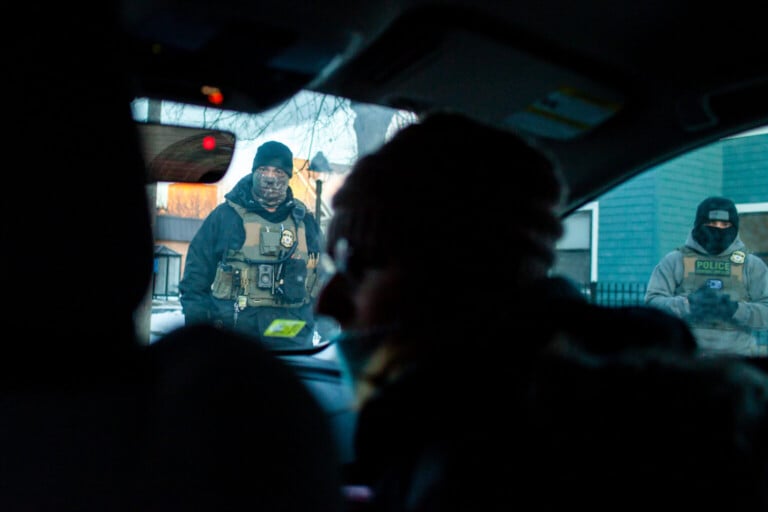
A man with a black face covering and a tactical vest peeking through his flannel shirt exited his car and approached the passenger door, gesturing for O’Keefe to roll down the window.

A masked agent with his vest partially visible through the buttons of his plainclothes shirt blocks in and approaches the car Elle Neubauer was driving on an early morning watch in Bloomington Friday, Jan. 9, 2026. (Photo by Nicole Neri/Minnesota Reformer)
“No, thank you,” Neubauer said, smiling and waving at the man.
“Stop following us,” he said, his voice muffled through the closed car window and the gaiter. “This is your first warning.”
Neubauer and O’Keefe started patrolling their south Minneapolis neighborhood recently as the Trump administration has ramped up its mass deportation campaign in Minnesota, sending in thousands of ICE and Border Patrol agents, with more on the way. They are some of the many thousands of Twin Cities residents who have come together over the past year to protest ICE and divert the agents from their mission, often resulting in tense confrontations.
Minnesota has been the focus of President Donald Trump’s deportation efforts since December, when a right-wing media outlet published unsubstantiated allegations that Somali Minnesotans were funding terrorism with money stolen from government programs. Homeland Security Secretary Kristi Noem announced “Operation Metro Surge” in December, which purported to target Somali immigrants, the vast majority of whom are citizens or legal permanent residents.
The effort to disrupt ICE operations has only grown in the days after ICE agent Jonathan Ross fatally shot Renee Good in her car in south Minneapolis, as Minnesotans look for ways to push back against what many view as an occupation of the city by unwelcome federal forces. There are now at least four times more immigration agents in the state than there are Minneapolis police officers.
Citizen observers are gathering on street corners and posting on social media to connect with each other, and immigrant rights organizations are quickly reaching capacity at training sessions for people who want to learn how to support and defend immigrants.
ICE did not respond to the Reformer’s emails for comment for this story.
Homeland Security Secretary Kristi Noem said Good was attempting to run over a federal agent in an act of “domestic terrorism.” Appearing on a Sunday morning Fox News show, Noem said her agency is investigating the funding behind anti-ICE operations, and claimed nonprofit organizations are training people to “distract them, assault them and do exactly what we’ve seen with these vehicle rammings.”
After the man finished talking to the patrollers and got back in the white Explorer, a second vehicle — a black GMC Yukon SUV— pulled in behind him, blocking in Neubauer’s car while the Explorer drove away.

Elle Neubauer and Patty O’Keefe are blocked in by a second layer of federal agents while on an early morning watch in Bloomington, looking for ICE vehicles to follow and observe Friday, Jan. 9, 2026. (Photo by Nicole Neri/Minnesota Reformer)
Neubauer and O’Keefe followed the black SUV out of the parking lot.
“I wonder how many first warnings we can get today,” O’Keefe said, half-jokingly.
She evidently ran out of warnings two days later, when federal agents smashed in her car window, dragged her and her co-pilot out of the car, and held them for eight hours in the belly of the Whipple Federal Building.
Neighbors join forces to track ICE, warn potential targets
When Trump assumed the presidency for the second time, immigrant rights activists landed on a strategy to respond to the coming increase in immigrant arrests: rapid response networks. Grouped by geographic proximity, they would quickly arrive at the scene of an ICE raid to protest, warn nearby neighbors, tell detainees about their rights and convince agents to leave. A common tactic is pointing out that agents can’t enter private property without permission or a judicial warrant.
Around the country, as ICE deployments escalated in cities like Chicago and Los Angeles, anti-ICE protesters have adopted and spread the tactics of honking horns and blowing whistles to alert entire city blocks to agents’ presence. The practice has become common in the Twin Cities, especially since “Operation Metro Surge” began in December.
Over the past year, immigrant rights groups have hosted “know your rights” trainings for immigrants and rapid responders, outlining the laws governing ICE and the protocols observers should follow to avoid arrest. At these trainings, neighbors meet each other and plug into their local rapid response networks.
Following cars, making noise and filming law enforcement operations is legal, according to Tracy Roy of the Immigrant Law Center of Minnesota. Physically blocking ICE agents from making an arrest is not. (And getting arrested, Neubauer said, takes resources away from the movement, in addition to the high personal cost.)
Rapid responders have gathered en masse at protracted federal raids in Minneapolis and St. Paul in the past year, resulting in standoffs between protesters and ICE, in which ICE agents used physical force, pepper spray and tear gas on the demonstrators.
But with the explosion in new agents arriving to the state, federal tactics seem to have shifted: ICE agents are conducting arrests quickly, in smaller groups than those that have provoked mass protest. By the time rapid responders arrive at the scene of a reported immigration raid or arrest — even if it only takes a few minutes — the ICE agents are often long gone.
So, the rapid responders have gotten more proactive, setting off on neighborhood patrols, finding and following ICE agents to try to discourage them from making arrests. They also film the agents in action to document potential violations of the law.
“If they know that somebody is watching, they’re significantly less likely to stop somebody,” Neubauer said. “Often when they pull over and people hop on a whistle or on their horn, they’ll just leave.”

Elle Neubauer drives with Patty O’Keefe through South Minneapolis on an early morning watch, looking for ICE vehicles to follow and observe Friday, Jan. 9, 2026. (Photo by Nicole Neri/Minnesota Reformer)
In group chats, neighbors using anonymous nicknames volunteer to assist with various aspects of the operation. No one assigns shifts or jobs; group members take on a needed role when they’re available, alert the group to their activities and let everyone know when they’re done.
The system is both highly organized and decentralized, with no clear leaders — just longer-time members of the network helping newcomers learn the communication style and security practices of the group.
As Neubauer drove on Friday morning’s patrol, O’Keefe monitored their local chat and listened to a group call. Both looked for what they’d learned were the hallmarks of ICE vehicles: out-of-state license plates, tinted windows, at least two people in the car — usually male, almost always masked.

Elle Neubauer drives while Patty O’Keefe monitors a rapid response group as they drive through South Minneapolis on an early morning watch, looking for ICE vehicles to follow and observe Friday, Jan. 9, 2026. (Photo by Nicole Neri/Minnesota Reformer)
When they spotted a suspicious vehicle in Bloomington, Neubauer maneuvered into position to follow it. An immediate giveaway that the vehicle belongs to federal agents, the patrollers said, is that the drivers quickly realize they’re being followed and start driving erratically. Early Friday morning, O’Keefe and Neubauer suspected a vehicle carried ICE officers; it aggressively accelerated towards Neubauer’s car while she made a U-turn at an intersection. Another vehicle they were following ran a red light, leaving the patrollers’ car behind.

An unmarked SUV that observers identified as a vehicle of federal agents accelerates toward Elle Neubauer as she makes a U-turn while she and Patty O’Keefe drive through South Minneapolis on an early morning watch, looking for ICE vehicles to follow and observe Friday, Jan. 9, 2026. (Photo by Nicole Neri/Minnesota Reformer)
“Well, if my plate wasn’t in their database, it is now,” Neubauer said Friday as she and O’Keefe followed the black SUV that had just boxed them in.
O’Keefe shared a description of the car and its license plate number so it could be added to the observers’ crowdsourced list.
As a countermeasure to the activists’ license plate tracking, ICE agents have been frequently switching license plates, drawing a warning from state regulators.
Even after they lost the SUV — the driver cut abruptly across several lanes of traffic — the encounter was a successful waste of ICE resources, in the patrollers’ eyes. ICE had dedicated an entire vehicle to impeding the observers for several minutes, rather than conducting arrests.
“Deep breaths,” Neubauer said, reaching over to pat O’Keefe on the leg.

Elle Neubauer and Patty O’Keefe check in with each other after being blocked in by federal agents as they drive through Bloomington on an early morning watch, looking for ICE vehicles to follow and observe Friday, Jan. 9, 2026. (Photo by Nicole Neri/Minnesota Reformer)
Managing one’s own emotions and staying calm is key to patrolling, because ICE agents are “emotional and not well-trained,” Neubauer said.
‘I feel changed’
Neubauer and a different observer were following three apparent federal vehicles Monday when the convoy pulled onto a side street and came to a stop. Five agents hopped out of their vehicles, and one wearing a face covering and ICE vest approached the drivers’ side window as the others surrounded the car.
As he approached the window, he greeted the driver with Neubauer’s wife’s legal name — the name on the car’s registration.
“If you keep following us…we’ll have to pull you out and arrest you,” the agent said. Neubauer and her co-pilot decided to keep following them — after all, they figured, they weren’t doing anything illegal.

A masked ICE agent knocks on the window and tells Elle Neubauer and the other observer she was riding with to stop following ICE vehicles while on an early morning watch Monday, Jan. 12, 2026. (Photo by Nicole Neri/Minnesota Reformer)
The convoy took them straight to Neubauer’s house, where they stopped and idled for a few minutes before moving on.
According to a lawsuit filed by the American Civil Liberties Union, ICE agents have routinely identified the drivers following them, then led them to the observers’ home — apparently using a law enforcement database to connect license plate numbers to drivers’ home addresses in an effort to intimidate observers.
On Monday, they took the intimidation tactics one step further.
Two cars split off from the group, and Neubauer and her partner for the day decided to follow the third vehicle, a grey pickup truck. They stayed close behind for several minutes until they realized the truck was leading them towards the Whipple Federal Building.
As Neubauer and her co-pilot followed the truck, agents returned to Neubauer’s house and banged on the front door. Her wife, who asked the Reformer not to publish her name out of fear of ICE, pretended she wasn’t home. The agents left after several neighbors stepped out of their houses and started blowing whistles.
When Neubauer realized what had happened, she called off the patrol and headed home.
“I feel changed, and afraid,” Neubauer’s wife said, looking at Neubauer. “I was very fearful — not for me, but for what could have happened to you.”
They set out on another patrol that afternoon, together.

Elle Neubauer holds her wife’s hand after coming home from and early morning watch observing ICE in South Minneapolis Monday, Jan. 12, 2026. While following a convoy of agents, agents drove to Neubauer’s home and idled for a bit. Agents then led Neubauer away while others circled back around to pound on her door. (Photo by Nicole Neri/Minnesota Reformer)
Killed in the act
Since Ross shot and killed Good, immigrant rights activists and elected officials have referred to her as an “observer.”
When Neubauer saw video of the shooting, however, she noticed something that suggested Good may not have been trained, or experienced, in interacting with ICE: Her window was rolled down, and she was speaking to the agents, against the advice of many immigrant rights activists.
“The shooting on Wednesday was 1000% not Renee’s fault. It was an ICE officer panicking and shooting into her car,” Neubauer said. “If we can manage the emotions of ICE officers so they’re not panicking … they’re less likely to f*ck up and make a mistake and hurt someone.”
Several leaders of immigrant rights groups and members of Good’s local neighborhood rapid response network told the Reformer they did not know Good.
Even if Good were in the group chat, the people interviewed by the Reformer may not have known, because they use code names and generally do not know each other’s real identities.
Friday morning, one patroller spoke up in the group call to say their car had been boxed in and ICE agents were approaching.
Another group member repeated the collective mantra: Lock your doors, roll up the windows, do not engage.

Elle Neubauer and another observer drive past wheat-pasted posters of Renee Good while on an early morning watch observing ICE in South Minneapolis Monday, Jan. 12, 2026. (Photo by Nicole Neri/Minnesota Reformer)
Broken glass
Sunday morning, O’Keefe was patrolling south Minneapolis with her friend Brandon Sigüenza when they heard ICE agents had surrounded another patroller’s car and were deploying pepper spray. When they arrived at the scene, they saw two federal vehicles surrounded by people blowing whistles and honking horns, O’Keefe said.
The agents got back in their cars and drove away. O’Keefe and Sigüenza followed them down a residential street until the vehicles stopped in the middle of the road and agents came up to the car — again giving them a “final warning” to stop following the officers, O’Keefe said.
O’Keefe shouted through the closed windows that she wasn’t obstructing them and that they could move forward if they wanted to, she said.
Sigüenza, for his part, said he kept repeating Renee Good’s name.
As the agents were walking back to their cars, one turned around and sprayed pepper spray into the car’s intake vent, Sigüenza said.
The pair continued following the convoy, O’Keefe honking her horn, until the agents stopped and got out of their cars again.
This time, they shattered both front windows and dragged Sigüenza and O’Keefe from the car, according to video captured by observers. Sigüenza said both of their phones flew from his hands, his landing in the frozen street. Agents handcuffed both activists and placed them in separate unmarked vehicles bound for the Whipple Federal Building, they said.
O’Keefe said the agents ridiculed her while she was in the backseat of the car.
“You guys gotta stop obstructing us,” O’Keefe recalls one agent saying. Then, referring to Renee Good: “That’s why that lesbian b*tch is dead.”
O’Keefe became enraged, calling the agent a “f*cking bigot.” She committed his comment to memory and quoted it to everyone she could inside the Whipple Building, she said.
The U.S. Department of Homeland Security did not respond to requests for comment Monday.
O’Keefe’s partner, Mitch Ditlefsen, called her as he was leaving his job as a prep cook at around 9:45 a.m.

Brandon Sigüenza, who was detained alongside Patty O’Keefe the previous day, talks about his experience alongside O’Keefe’s partner, Mitch Ditlefsen Monday, Jan. 12, 2026. (Photo by Nicole Neri/Minnesota Reformer)
“Someone picked up and said, ‘The owner of this phone has been abducted by ICE,’” Ditlefsen said.
“I showed up, and there was just shattered windows and pepper spray, and no indication of where Patty and Brandon were,” Ditlefsen said.
The pair said they spent eight hours in custody, mostly in holding cells with other U.S. citizens who said they were also arrested while protesting ICE. O’Keefe said she was never provided a phone call; Sigüenza was able to call his wife.
While in custody, Sigüenza said, agents suggested they would pay him or expedite immigration proceedings for his relatives if he provided the agents with names of undocumented immigrants or protest organizers. Both were released without charges.
Sigüenza said he’ll take a short break from patrolling for his wife’s sake — she feared for his safety long before his arrest — but he’s ready to get back out there.
O’Keefe said the experience has strengthened her resolve, but also ratcheted up her fear.
“They don’t realize this is coming from a deep place of love and empathy and care for my community,” O’Keefe said. “And that is a stronger feeling that I have in me than fear.”
Feeling besieged, a neighborhood fights back
When thousands of people showed up to mourn Good at a vigil the night she was killed, organizers urged attendees to get connected to their local immigrant defense networks in whatever role they are comfortable with.
Everyone has different skills and risk tolerances, Neubauer said, so there’s a role for everyone. For example, going door to door to meet one’s neighbors is one important way to increase safety and support people who may be staying home for fear of ICE, Neubauer said.
“But honestly, I have too much social anxiety,” she said. “It was just too much for me to do that. And for whatever reason, my brain works in such a way where (patrolling) is less anxiety-inducing than talking to my neighbors door-to-door.”
She wouldn’t be able to deal with the emotional toll of patrolling without support from her wife, she said. The movement needs all kinds of help; whistles and volunteers to distribute them; plate checkers and people to coordinate among different networks in various languages; food delivery for immigrants sheltering in place.
And, more people in more neighborhoods who are ready to jump into action when ICE shows up next door.

Thousands gathered at Portland Avenue near 34th Street in south Minneapolis to honor the life of Renee Good, who was killed by an ICE officer that morning Wednesday, Jan. 7, 2026. (Photo by Nicole Neri/Minnesota Reformer)