Ballot measure discussion prompts criticism of lawmaker ‘power grab’
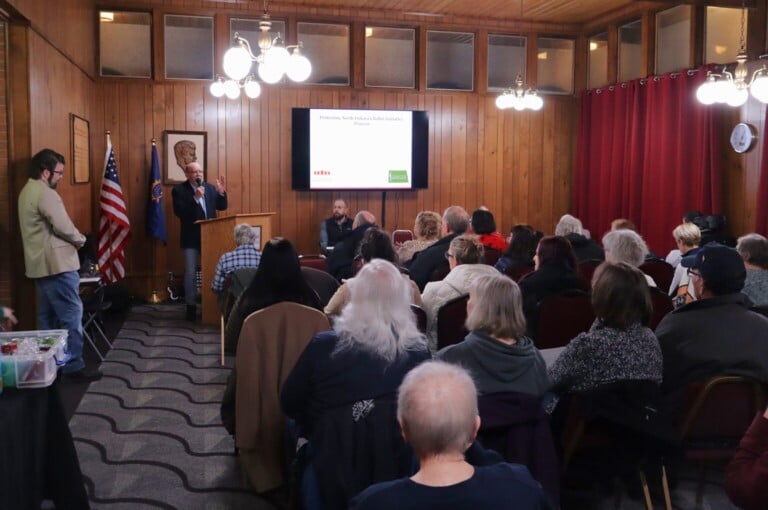
BISMARCK, N.D. (North Dakota Monitor) — A discussion on three North Dakota ballot measures advanced by state lawmakers drew criticism from attendees on Monday with some opposed to changing the initiated measure process.
About 50 people gathered at the Kennedy Center in Bismarck to learn more about measures that will be on the June and November ballots. The event, hosted by the North Dakota Watchdog Network and the Dakota Resource Council, is part of a series being held across the state.
“There’s a constant need for education because every time the Legislature meets, there seems to be these in-roads trying to remove the public from their decision-making process,” said Brad Carroll of Bismarck.
He said there seems to be a repeated “ebb and flow” of North Dakotans trying to constrain the Legislature and lawmakers trying to curtail the public.
Measure 1, which will be on the June 9 primary ballot, would require future constitutional ballot measures from an initiated petition or legislative resolution to be a single subject.
Dustin Gawrylow, managing director of North Dakota Watchdog Network, said the measure doesn’t define what a single subject is, leaving it open to interpretation by the secretary of state.
Gawrylow added that voters rejected a ballot measure with a single subject requirement two years ago. The November 2024 ballot measure also contained other provisions, including requiring voters to approve a measure twice, once in a primary and again during a general election. The measure also would have increased the signature requirement for ballot measures from 4% of the state population to 5%.
A ballot measure known as Measure 2 that will go to voters during the Nov. 3 general election would require future constitutional measures to gain support from 60% of voters rather than a simple majority. The increased threshold would apply to citizen-initiated measures and legislative resolutions that would change the state’s constitution.
“The folks that support this say that the North Dakota Constitution is too easy to change and the state constitution should be as static as the national Constitution, which rarely ever gets changed,” Gawrylow said.
He said a 60% requirement actually empowers the minority.
“Forty percent plus one can tell the other 60% minus one what not to do,” Gawrylow said.
Gawrylow pointed to historic ballot measures that passed with less than 60% support, including the 1919 measure that established the state-owned Bank of North Dakota.
Taylor Johnson of Bismarck said North Dakotans seem happy with the initiated measure process as it is now.
“It can cut through some of the noise of partisan politics, and I think it really helps us come together as a community and decide things for ourselves,” Johnson said. “I’m frustrated with the repeated, I guess, power grabs from the Legislature.”
Ellen Chaffee, a member of the BadAss Grandmas for Democracy, a group that spearheaded an initiated measure in 2018 to establish the state’s Ethics Commission, said it’s never been more clear that state government officials do not respect the wishes of the people.
“You get seduced by the power and you come to own it as your own, unless you are really careful,” Chaffee said. “That’s what’s happened to them (state lawmakers). They think they’re that smart. They think they’re that right…and they think you are wrong.”
She said initiated measure processes across the country are being championed by pro-democracy causes and organizations.
November’s Measure 1 would allow lawmakers to change the state’s term limits law to allow legislators to serve up to 16 years in one chamber instead of eight years in the House and eight years in the Senate. It would also repeal a section of the term limits law that prohibits legislators from altering or repealing the term limits law. The ballot measure is being challenged in court, with the North Dakota Supreme Court expected to hear the case this spring.
North Dakota Monitor reporter Michael Achterling can be reached at machterling@northdakotamonitor.com.