AI driving rise in child sexual abuse material cases, North Dakota investigator says
BISMARCK, N.D. (North Dakota Monitor) — A member of the North Dakota Bureau of Criminal Investigation told state lawmakers Wednesday the agency needs more tools to address a rise in child sexual exploitation involving images generated by artificial intelligence.
“Child exploitation has always existed, but what AI has done is made it faster, easier and more scalable while making it harder for us to detect and investigate,” Cassidy Halseth, commander for the North Dakota Internet Crimes Against Children Task Force said.
The BCI received about 2,700 online tips in 2025 about child sexual abuse material, a record for the department. Many of the cases involved AI-assisted exploitation.
“AI is being used to create explicit images from otherwise innocent photos,” Halseth said. “It’s being used to impersonate real individuals, peers, classmates, trusted adults and is facilitating perversion, sextortion and harassment.”
Nationally, he said more than 1.5 million AI-related child exploitation reports were made in 2025, a 1,300% increase over the previous year.
Last session, North Dakota lawmakers approved a bill that makes it a Class C felony to possess a computer-generated image of child sexual abuse material. The bill also added enhanced penalties for more egregious cases of child sexual abuse material.
Halseth said those policy changes were important, but his task force is seeing cases with AI-generated sexually explicit images involving minors that result in little or no jail time.
“When that happens, it undermines accountability, it minimizes the harm that is being done to these victims and it sends the wrong message to our offenders,” he said.
Greg Kasowski, executive director for Children’s Advocacy Centers of North Dakota, said instances where AI uses an ordinary photo of a minor and transforms that image into a sexually exploitative image should be treated the same as other cases involving child sexual abuse material.
Halseth also advocated for state investment in more technology to help investigators, ongoing training on artificial intelligence and wellness support for investigators.
“We really don’t have a strong budget for the equipment we actually need to do a better job in the state of North Dakota,” he said.
Rep. Bernie Satrom, R-Jamestown, chair of the interim Protection and Victim Services Committee, said the key to solving this problem is the same that created the problem, using AI.
“One click of the mouse can do the work of somebody working potentially for weeks and do a better job, quicker,” Satrom said. “We need to make sure they have those resources.”

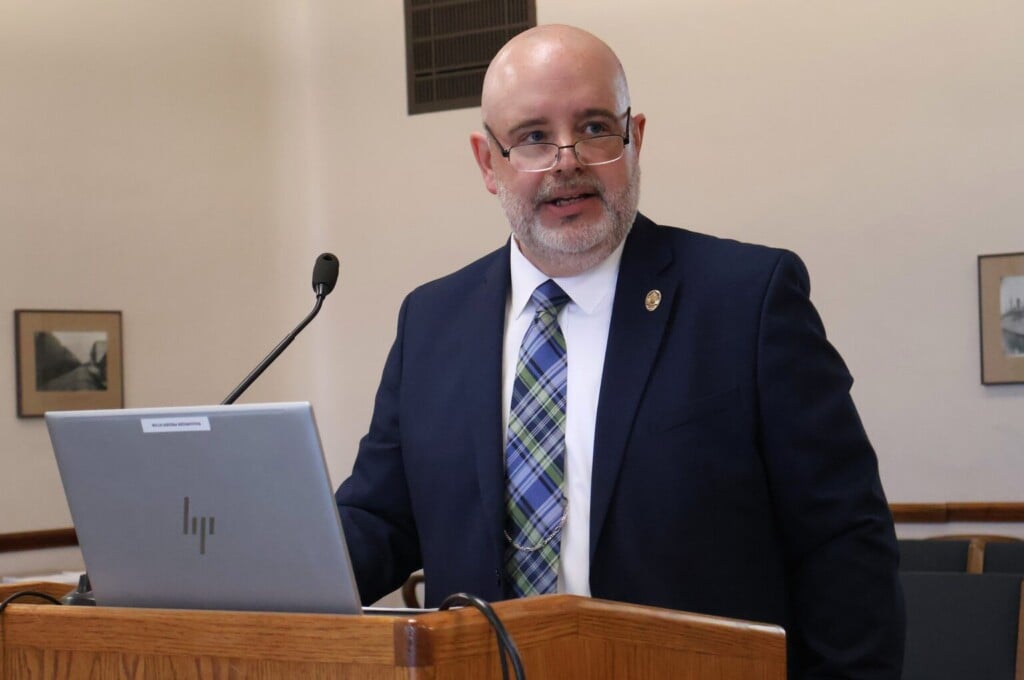
Rep. Bernie Satrom, R-Jamestown, speaks during a legislative committee hearing on May 13, 2026. (Photo by Michael Achterling/North Dakota Monitor)
Halseth said the AI-generated child sexual exploitation can produce a trauma for the victim that can be as serious as real-life exploitation.
“These images, they can exist forever,” he said. “They can resurface at any time, can follow victims into schools, careers and even into relationships … This is not temporary damage. It is permanent harm tied to a person’s identity.”
Satrom said he also supports continuing funding for victim services.
Sen. Keith Boehm, R-Mandan, vice chair of the committee, said the BCI does not have enough resources to tackle the increasing caseload of AI-generation child sexual exploitation.
He added he wants to ensure “meaningful and accountable” sentencing is occurring in these exploitation cases even if the content was generated with AI.
The committee prepared a bill draft to update definitions and language surrounding child sexual abuse materials and obscenity controls. The bill may be considered by Legislative Management this fall and advanced to the 2027 legislative session.
Halseth also urged more education.
“We need more education with our parents and we need more education in our communities to explain not only the dangers of AI, but how AI works day in and day out,” he said.
Kasowski said his organization has been invited by multiple schools in North Dakota to conduct training on child sexual abuse with students and, with a little more funding, he believes state nonprofits could provide training for a majority of the state’s K-12 schools.
“In rural areas, there’s a gap,” he said.
By Michael Achterling.