Oil field waste could fuel a new industry in North Dakota, proponents say
BISMARCK, N.D. (North Dakota Monitor) — An unwanted byproduct of North Dakota’s oil field could be the key to unlocking a new industry in the state within the next few years.
An international company is proposing to begin extracting lithium, a key component of batteries produced for smartphones and other technology, from produced water by the end of 2027. It’s one of at least four similar projects in development in the state.
Troy Coons, chair of the Northwest Landowners Association, is urging companies to involve affected property owners from the start.

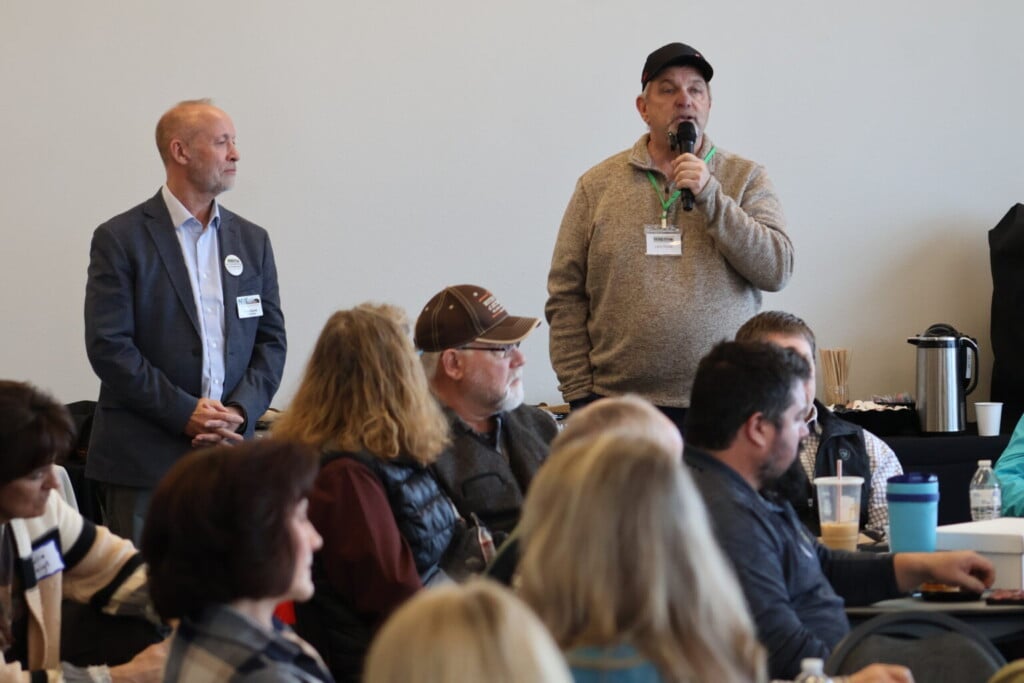
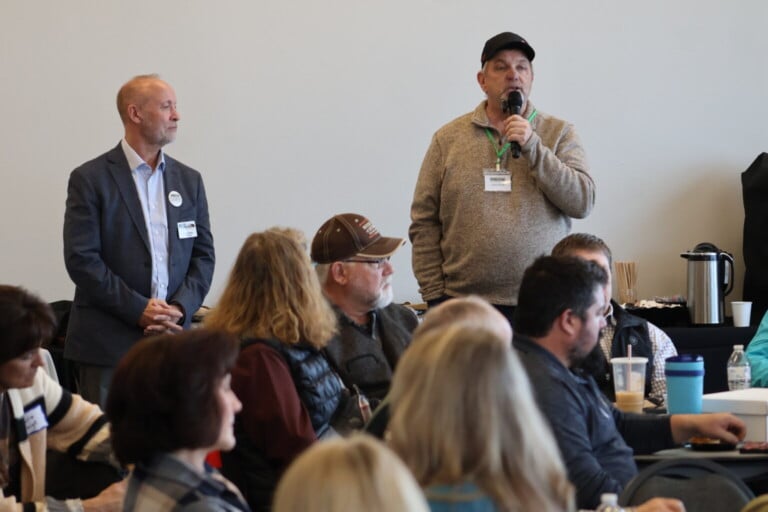
Troy Coons, chairman of the Northwest Landowners Association, speaks during the organization’s emerging industries conference on Feb. 2, 2026.
“None of this happens without landowners,” Coons said during a Bismarck conference this week focused on emerging industries. “We believe landowners deserve a seat at the table.”
Lithium Harvest, a Denmark-based company with a presence in the United States, is partnering with an unnamed oil company to construct two lithium extraction facilities in western North Dakota. The facilities will process produced water, the salt water that comes to the surface with crude oil, according to co-founder Paw Juul.
“It actually makes it possible for both the landowner, but also the producers, to earn money on a waste stream,” Juul told landowners on Monday.
Lithium is considered a critical mineral by the U.S. Department of the Interior. The United States is looking to increase domestic production to rely less on China.
Traditionally, lithium is extracted from hard rock mining, with projects that can take seven to 15 years to develop, Juul said.
Lithium Harvest’s technology allows the company to construct small extraction facilities in under two years, he said.
The company proposes to build the facilities on the same site as saltwater disposal wells, where produced water, also called brine, from oil wells in the area is already transported by pipelines to a central point for disposal underground.
“This site is able to produce roughly 1,500 tons a year of lithium carbonate, which we then can sell into the market, either directly to battery manufacturers or we can sell it into the futures market as a regular commodity,” Juul said.
The company also is looking at the possibility of extracting other critical minerals, such as magnesium, from the same stream of produced water.
Lithium Harvest isn’t the only company planning to extract lithium from produced water in North Dakota. Tom Oakland, energy and economic development manager at the North Dakota Department of Commerce, said there are at least four such projects in the works.
“They have different technologies, but there’s a lot of interest in that area of growth,” Oakland said.
The North Dakota Industrial Commission approved a $500,000 grant to Wellspring Hydro, another company working to extract lithium from produced water, in October 2025.
Lithium Harvest’s project is being internally financed by the company without government grants or loans, Juul said.
The Department of the Interior has published a list of 60 minerals, including lithium,considered vital to the U.S. economy and national security. Some but not all are also rare earth elements, naturally occurring substances that are rarely discovered in quantities that are economically viable to produce.
China has had a “global monopoly” on critical mineral development due to a combination of geology, foresight and early investment, said Levi Moxness, a senior geologist for the North Dakota Geological Survey.
The United States and other countries are looking to break that stranglehold, and the leverage it gives China in geopolitical negotiations, by encouraging domestic production. North Dakota is one potential source.
The North Dakota Geological Survey has discovered the state’s coal seams often contain unusually high concentrations of rare earth elements like gallium and germanium, elements essential for technologies as varied as computer chips and night vision goggles.
The agency has spent the last decade collecting samples across western North Dakota, including in the Badlands, to better understand what rock formations these minerals can be found in. But Moxness emphasized the sampling occurs in the Badlands because that’s where they can easily obtain samples close to the surface. Any mining would likely occur in traditional coal-mining regions, he said.
“You don’t want to mine in the Badlands,” Moxness said.
Larry Novak, a landowner in McKenzie County and member of the Northwest Landowners Association board, said he supports development, but also cherishes the region’s natural beauty and would like to see industry work with landowners to minimize the impact on the land.
“Certainly critical minerals are important to the state of North Dakota and also the country,” Novak said. “But if we can do it on a non-invasive area, I guess it would be something I’d be in support of.”
Novak said he believes lithium is going to be the next big industry in North Dakota, and he wants landowners to be involved early on to ensure they are fairly compensated.
“If our forefathers had known what we know now about oil development and whatnot, we would all be in better shape,” Novak said. “So lithium is our chance to get on the ground floor.”
North Dakota Monitor reporter Jacob Orledge can be reached at jorledge@northdakotamonitor.com.