Rural grocers find creative ways to serve customers, keep doors open
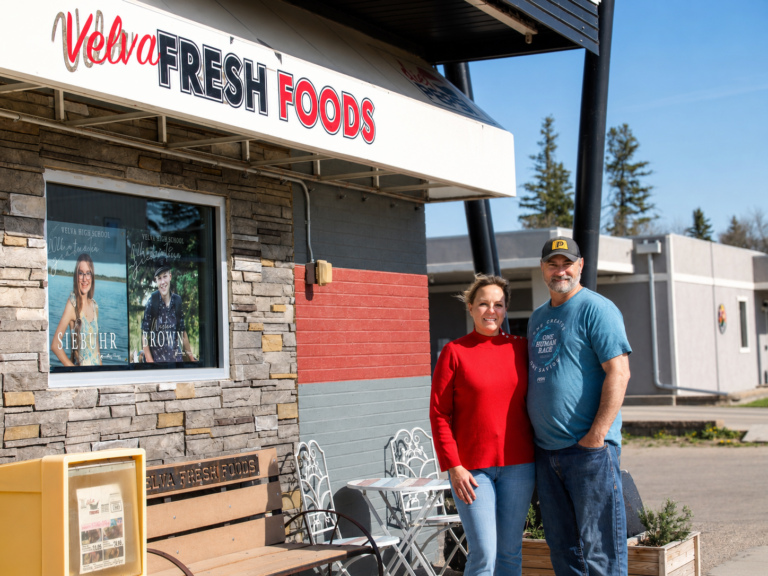
FARGO, N.D. (North Dakota Monitor) — Brenda and Matt McCasson have had to get creative to keep customers coming back to their grocery store in Velva.
“It’s all about convenience,” Brenda McCasson told attendees of a three-day National Rural Grocery Summit in Fargo last week. “They don’t cook a lot. They’re busy. I get it. I’m a busy mom, too.”

Brenda and Matt McCasson, owners of Velva Fresh Foods, address the National Rural Grocery Summit in Fargo, North Dakota, on May 6, 2026. (Photo by Jeff Beach/North Dakota Monitor)
North Dakota and other states are looking for solutions to keep grocery stores in business in rural areas.
According to North Dakota State University Extension, North Dakota has 90 grocery stores, down from 137 in 2014.
Jodi Bruns, leadership and civic engagement specialist with NDSU Extension, noted that 90% of North Dakota’s communities have a population of fewer than 2,000 people.
That would include Velva, where the McCassons operate Velva Fresh Foods. One of the challenges for the McCassons is being just 20 miles away from Minot, North Dakota’s fourth largest city.
People will drive to do their grocery shopping there. Walmart also will deliver groceries to Velva.
“We’ve kind of taken a hit from that,” Matt McCasson said.
A Dollar General store in Velva also competes for business.
For the McCassons, some of their successful experiments have included adding a small liquor store space and adding in-store assembled frozen pizzas that can include local ingredients such as smoked meats.
They even offer deals where people can drop their Crock-Pot off at Velva Fresh Foods and the store will put in the ingredients, such as a beef roast, and cook it throughout the day. The customers can pick up the finished meal at the end of the day. The store puts a disposable liner in the Crock-Pot for easy clean up.
“We’re just trying to create more ways to bring people in the door,” Brenda McCasson said.
It hasn’t all gone smoothly for the couple. They took over the grocery store in Drake, a town with fewer than 300 people, about the same time as the COVID-19 pandemic hit.
At first, things went well, with people shopping closer to home because of the coronavirus. But as life returned to normal, so did people’s shopping habits and customers drifted away, the McCassons said.
They had to close the Drake store to focus on Velva.
“You feel like you’re letting people down,” Brenda McCasson said of the closure.
The North Dakota Association of Rural Electric Cooperatives would like to see fewer of those let-downs.
The association is helping a group of rural grocery stores in the Minot area work together on purchases to decrease costs. It has identified a building in Velva to use as a distribution hub with a walk-in freezer that has been donated.
Ellen Huber, rural development director for the group, said it is similar to a project in Walsh County, where several rural stores are buying as a group and benefiting from a distribution center in Park River. By purchasing as a group, the stores have reduced their wholesale prices by 16% to 17% on average, Huber said.
“It has allowed them to provide for their communities a much wider variety, higher quality, fresher foods, just helping with overall community vitality and quality of life,” Huber said.
The group also is working with Seedhead Strategies, a consulting group based in Missoula, Montana, and Washington, D.C.-based Center Market Strategies and on a study on grocery supply chains and challenges to independent grocery stores.
The study will be used to identify solutions that support small and local grocers.
Researchers used the event in Fargo to help gather information for store owners.

Velva Fresh Foods is a family owned grocery store that has to compete with larger stores in Minot, North Dakota, about 20 miles away. (Photo by Kyler Collom/For the North Dakota Monitor)
The grocery summit was organized by Kansas State University, the University of Minnesota Extension Regional Sustainable Development Partnerships and the North Dakota Association of Rural Electric Cooperatives. NDSU Extension was a sponsor of the event.
The North Dakota Legislature approved $1 million in grant funding in 2023 and again 2025 for rural grocery stores through the Department of Commerce. Commerce provided grants to 11 grocery stores in 2025 from 47 applications. Grants were capped at $150,000, with two stores getting the maximum grant. There was a total of $4.8 million in grant requests.
Reach North Dakota Monitor deputy editor Jeff Beach at jbeach@northdakotamonitor.com.