North Dakota lawmakers poised to act next week on federal rural health spending
Bill to expand authority of pharmacists among policy proposals to be debated
BISMARCK, N.D. (North Dakota Monitor) — North Dakota lawmakers took final steps this week to prepare for next week’s special session to authorize the spending of federal health care money.
Congress last year created the $50 billion for Rural Health Transformation Program as a way to offset losses rural states will incur due to Medicaid cuts.
North Dakota received $199 million for the first year of the five-year grant, but is also budgeting for the additional roughly $200 million it expects for the second year.
After the Legislature approves the money, the Department of Health and Human Services will allow groups to start applying for grants. The federal government will have to review and approve every grant.
“I can’t stress enough the short timeline for funding,” Donna Aukland, the agency’s chief financial officer, told lawmakers Tuesday.
The Legislature’s Rural Health Transformation Committee this week revisited four bill drafts to consider during the session that the state pledged to adopt in its application for the federal dollars. The federal government incentivized the policies by promising more grant money to states that enact them.
One bill would expand the prescriptive authority of pharmacists and allow them to order lab tests. Proponents of the policy say it would make it easier for North Dakotans to get treated for common conditions, especially for those in rural areas.
Under the proposal, pharmacists’ prescriptive authority would include drugs for conditions including the flu, COVID-19 and strep throat, as well as lice, cold sores, motion sickness, hypoglycemia and uncomplicated urinary tract infections. Pharmacists would also be able to prescribe the use of inhalers, nebulizers, diabetes blood sugar testing supplies and pen needles.
Additionally, pharmacists would be able to switch patients’ drugs to a substitute expected to have a similar therapeutic effect.
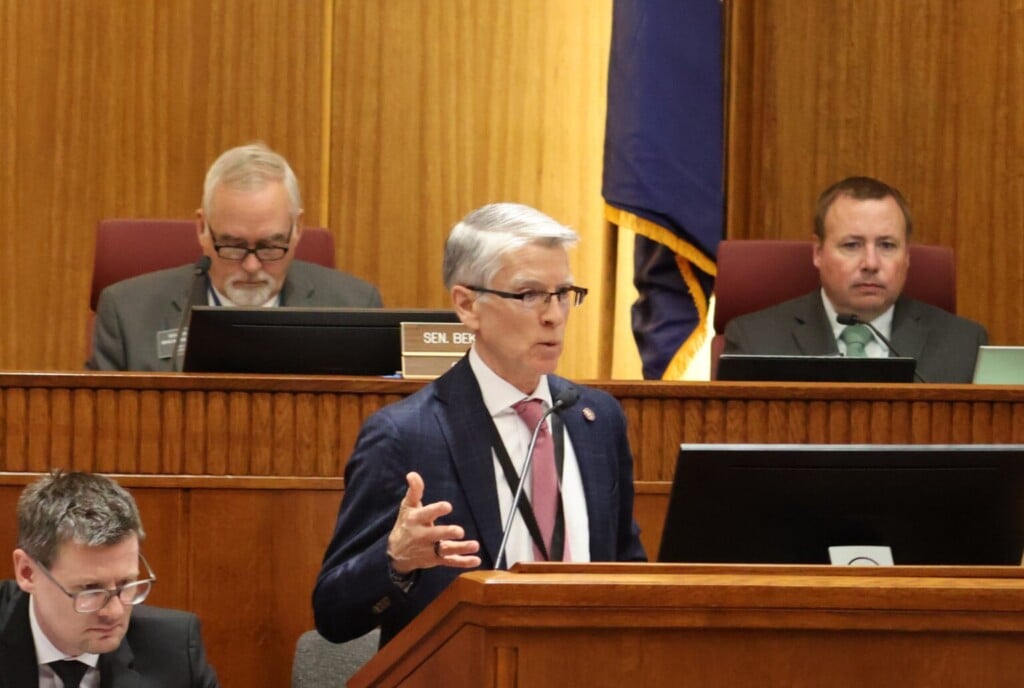
Sen. Kristin Roers, R-Fargo, on Tuesday said she’s concerned that this could be dangerous for sensitive groups.
“It is a fear for a lot of people, by having the language this broad it would allow for pharmacists to do therapeutic substitution for psychiatric meds for juveniles,” she said. She suggested that lawmakers should create an “exclusion list” that limit this prescriptive power in certain situations.
Roers, a nurse, also said the legislation should include more guardrails for the treatment of common diseases.
She recommended an amendment that would require pharmacists to conduct a lab test before they can prescribe medication for some conditions, including urinary tract infections.
“Without a lab test, I struggle to know how that’s uncomplicated,” Roers said.
The committee held off on approving the amendment but indicated lawmakers will discuss it again during the special session, which begins Jan. 21.
The committee also discussed draft legislation to have the state be part of a licensure compact for physician assistants.
Sen. Judy Lee, R-West Fargo, called physician assistants an “extremely important part” of rural health care in the state, and said the amendment could help address workforce shortages.
Lawmakers during the session will also likely consider adopting a one-hour continuing education requirement for doctors related to healthy eating.
“We’re talking about one hour, we’re not talking about one semester,” Lee said.
Another bill draft would require North Dakota K-12 students to participate in the presidential physical fitness test.
Traynor said Tuesday that he hadn’t reviewed the bill draft with Department of Public Instruction Superintendent Levi Bachmeier but that he’s confident the agency would support it.
“From a general perspective, he is very excited about physical activity and diet in the schools,” Traynor said.
States are guaranteed at least $500 million over five years from the Rural Health Transformation Program, but could receive up to $1 billion depending on the strength of their applications and other factors.
The $199 million awarded to North Dakota in late December is almost double the minimum funding available to states this year.
The state plans to budget $33.4 million of its award on technology, $116 million to expand health care access in rural areas, $32.2 million to address workforce issues and $17.1 million to promote healthy lifestyles.
North Dakota has until the end of September 2026 to obligate the funding, and until September 2027 to spend it.
The funding amounts to roughly $561 per North Dakota resident, according to an analysis by policy research organization KFF. Only six states received larger per-capita awards. The average grant amount was about $200 million per state.
It’s still unclear if lawmakers will allow bills on other topics to be introduced during the special session. Rep. Mike Nathe has said he’s drafting a bill related to providing school meals to all K-12 students for possible discussion. Legislative Council has drafted about 20 bills, but not all lawmakers plan to proceed with those proposals, Director John Bjornson said. The bill drafts have not been made public.
The Legislative Management committee will meet at 1 p.m. Tuesday to decide which, if any, additional bills will get introduced. Lawmakers have said they want to keep the session narrowly focused.
North Dakota Monitor reporter Mary Steurer can be reached at msteurer@northdakotamonitor.com.