Amid chaotic times, farmers and ranchers want their voices heard
BISMARCK, N.D. (North Dakota News Cooperative) — North Dakota farmers and ranchers with several generations on the land want people to know that this success is the very definition of sustainability.
Yet most are facing chaotic times that make it more difficult to operate and potentially pass their legacy on to their families.
For some, like Tony Schneider, a farmer and rancher and a board member of the North Dakota Barley Council, it’s time producers take more action explaining to the public what they do, how they do it, why they do it, as well as their importance to the state and country as a whole.
“Maybe there’s a little hope for agriculture to get its message out, when I see things like this here,” Schneider said. “People are so removed from agriculture they don’t know where their food comes from. I think that education is really important.”
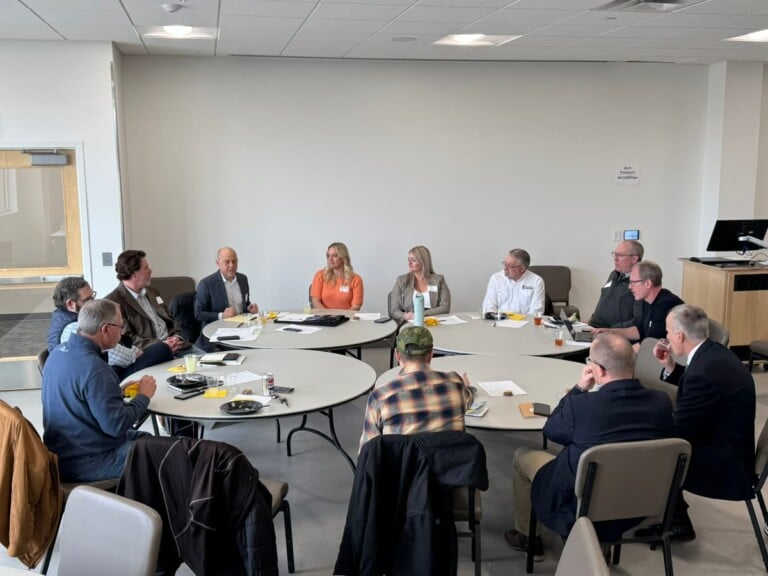
Schneider spoke after an off-the-record agricultural roundtable at North Dakota State University on March 12 jointly organized by the North Dakota News Cooperative along with Oakland, California-based PolicyLink.
The gathering of over a dozen farmers, ranchers and ag leaders was organized to get a better understanding of what challenges farmers in North Dakota face and how they see the future.
Livelihood impacts
What came out of the discussion was telling for those not steeped in the daily lives of farmers and ranchers.
Trade actions make long-term markets uncertain and volatile, inflation keeps input costs rising, a fresh war increases prices on petroleum products and strains fertilizer supplies, they say.
Trade stability and export markets are critical to that sustainability, particularly for a landlocked state like North Dakota.
They want people to understand how foundational agriculture is to the economy, to food security, and to rural communities, but that it also remains widely misunderstood.
Public perception and misinformation about farming practices are rampant and create uncertainty. On the other end, policymakers on the coasts are often not directly engaged enough with agricultural producers, leading to further misunderstanding.
PolicyLink, which cut its teeth trying to address urban food deserts in places like Pennsylvania two decades ago, initiated the discussions as part of a series of listening sessions nationwide. The organization aims to help build a country that works for everyone by grounding policy in real experience, reducing polarization and reconnecting urban and rural perspectives.
Josh Kirschenbaum, a senior advisor at PolicyLink who initiated the gathering, said the biggest “aha” for him was how long it takes to build markets and how easily they can be destroyed.
“Even for me, on this quest about how to deliver democracy for all, the thread about the interplay between the market and democracy and how that shapes governing, that was extremely enlightening and powerful,” Kirschenbaum said.
All the volatility impacts the generational transition of farming and ranching families across the state.
High land costs, debt, thin margins, and enormous financial risk can make it a daunting challenge to pass on a farm, leading to questions about who will continue farming in the future and what that means to food security and the communities farming supports.
While their communities know this, the wider public does not: farmers and ranchers are key to supporting local businesses, churches, schools and civic leadership. When farms disappear or consolidate, communities lose population, leadership and economic activity.
Fertilizer, fuel, machinery, insurance, and labor costs have all increased significantly while commodity prices have stagnated or declined in recent years. These rising costs are steadily shrinking profit margins.
Attendees also raised concerns about rural health care access, rising health insurance costs, and the loss of rural hospitals, making it more difficult to sustain families in rural areas.
Policies like support for renewable fuels were cited as a major success but that growth had stalled and that policies need to evolve to support higher biofuel blends and new markets, while also addressing foreign competition.
Policies like crop insurance were also seen as essential, but incomplete. They provide a necessary safety net, but don’t cover enough of a producer’s potential revenue.
Telling their story
On the public misconceptions side, examples included confusion about GMOs, pesticides, fertilizers and organic farming, with producers saying they’ve struggled to tell their story and have allowed misinformation to fill the gap.
Most emphasize that they already prioritize stewardship and sustainability because their livelihoods depend on protecting soil, water, and land for future generations taking over their operations.
Schneider of Ashley said farmers need to get more active if they want their voices heard.
“If you’ve got grain or livestock and you’ve got a commodity in your operation that’s making you financially sound, you’ve got to get involved and get on boards,” he said.
“You’ve got to be at the table, not on the table, for that commodity and that makes a difference. That’s the most important thing they can do.”
Kirschenbaum said most people don’t think that deeply about food and connect that to the policies that impact the people producing it and the communities they live in.
“The vulnerability and the volatility that all the externalities can have on our food systems is tremendous,” he said. “I don’t think Americans know that, and being able to tell that story is important.”
Other attendees included Carson Klosterman, a farmer and representative of the North Dakota Corn Council; Lance Gaebe of the North Dakota Farmers Union; Dallas Loff, a farmer and representative of the North Dakota Soybean Council; Dr. Greg Lardy of NDSU; David Boehm, director of the Northern Crops Institute; generational farmer and rancher Garrett Bladow; agricultural reporter Rusty Halvorson; Monte Peterson representing the Soybean Growers Association; Jed Brazier and Tony Richards of NorthHarvest Bean Growers Association.
The event was moderated by Cally Peterson, co-chair of NDNC, and NDNC CEO Sabrina Halvorson.
The North Dakota News Cooperative is a nonprofit news organization providing reliable and independent reporting on issues and events that impact the lives of North Dakotans. The organization increases the public’s access to quality journalism and advances news literacy across the state. For more information about NDNC or to make a charitable contribution, please visit newscoopnd.org. Send comments, suggestions or tips to michael@newscoopnd.org. Follow us on Twitter: https://twitter.com/NDNewsCoop.