North Dakota revenues on track, but face uncertainty due to oil price volatility
BISMARCK, N.D. (North Dakota Monitor) — North Dakota state revenues remain on target for now amidst unpredictable oil prices, but budget officials urged caution.
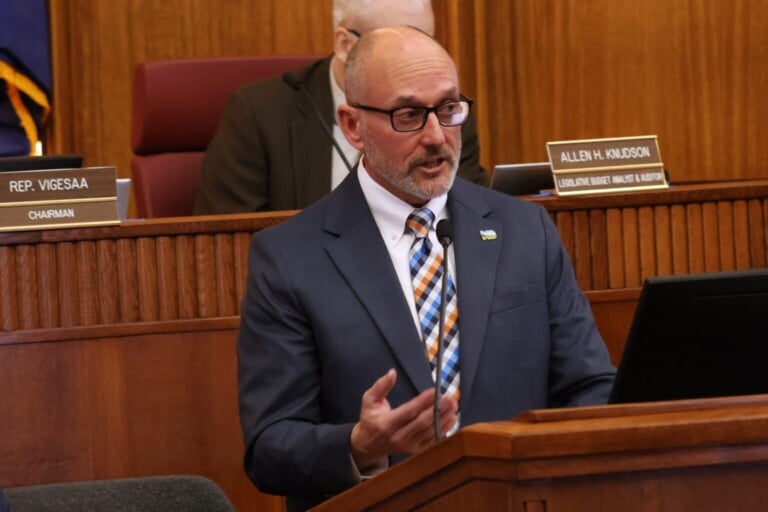
“There’s really a perfect example of North Dakota’s volatile revenues,” Allen Knudson, budget analyst and auditor for Legislative Council, told lawmakers Wednesday afternoon. “It’s way up one day and way down the next.”
Oil prices have greatly fluctuated in recent weeks amid the United States’ and Israel’s war in Iran. Before that, prices were low due to high supply.
Last month, the price for North Dakota crude oil was about $50 a barrel, but is now about $80 and potentially going up, Knudson said. That $30 per barrel increase equates to about $3 million in additional state revenue each day, he said.
“It’s looking good now, but again, it could change in a short amount of time,” he said. “We’ll need to proceed with caution.”
Overall, North Dakota revenues as of Feb. 28 were in line with state forecasts.
Under the budget approved by the Legislature last year, the state expected to pull in $1.687 billion in revenue between July and February. The state’s actual revenue over that time frame was $1.689 billion, North Dakota Office of Management and Budget Director Joe Morrissette told lawmakers Wednesday morning.
“We’re about $2 million ahead of forecast, which is a very, very small margin of error, a 10th of a percent variance,” he said.
North Dakota has exceeded budget projections in recent years, including beginning the 2025-27 budget cycle with a surplus of $1.3 billion in the general fund. Budget officials are not expecting to have large surpluses ahead of the 2027-29 budget cycle, however. That prompted the state to offer voluntary buyouts to state employees last month.
A total of 19 state agencies are taking part in the program, and about 200 state employees participated in a call to learn about the incentive, Morrissette said.
The window for employees to apply for the voluntary buyouts is March 31.
In 2018, the last time the state offered similar retirement incentives, 200 employees participated, Morrissette told lawmakers.
Rep. Eric Murphy, R-Grand Forks, said he’s concerned that voluntary buyouts could result in agencies losing some of their best employees.
“Replacing more expensive employees with less expensive employees, the reality is, we’re also losing that much institutional knowledge,” he said.
North Dakota is projected to collect about $130 million less in individual and corporate income taxes due to changes in the One Big Beautiful Bill Act. Morrissette said Wednesday the state doesn’t expect to know the full impact of the bill on state tax collections until after April.
As of Feb. 28, corporate income tax revenue came in at roughly $134.2 million, or 17.4% greater than what was forecast.
Sales tax revenues — the state’s largest general fund revenue source — as of February were roughly the same as projected in the budget forecast.
The state expects to make a total of $5.3 billion in revenue over the course of the 2025-2027 budget cycle, which ends June 30, 2027.
Lawmakers on Wednesday also approved four requests from executive branch agencies for gap funding forwarded by the North Dakota Emergency Commission.
The North Dakota Department of Corrections and Rehabilitation asked for $105,000 in state general fund contingency money so it can start using GPS monitoring for people in transitional and work release programs.
The three other requests were for authority to spend federal money.
The North Dakota Department of Public Instruction asked for approval to spend $5.26 million as part of a federal education research grant to expand an artificial intelligence-assisted reading tutoring program for grade schoolers.
The North Dakota Department of Health and Human Services requested authority to accept $1.96 million in federal funds for technology upgrades to its Medicaid system.
The agency also requested authority to accept $1.19 million from the U.S. Department of Agriculture for technology upgrades to make the state’s Supplemental Nutrition Assistance Program more efficient and to reduce errors.
In both cases, the funding going to the North Dakota Department of Health and Human Services is needed to comply with federal requirements implemented in the reconciliation bill passed by Congress last year, Morrissette said.
North Dakota Monitor reporter Mary Steurer can be reached at msteurer@northdakotamonitor.com