Poor culverts, inspections led to North Dakota derailment, report says
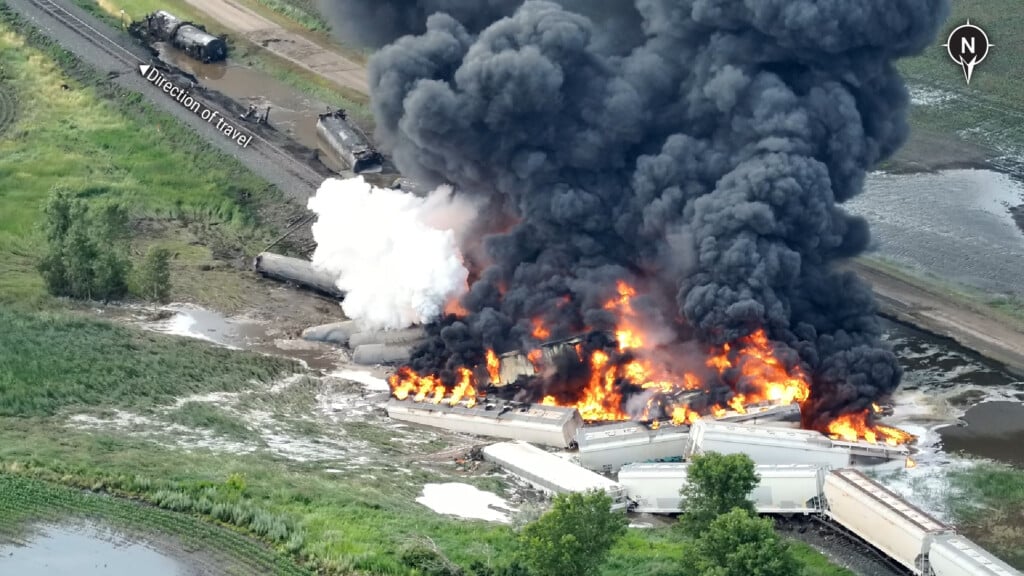
BORDULAC, N.D. (North Dakota Monitor) — A new report on a fiery train derailment in North Dakota points to deteriorating culverts below the tracks and poor-quality inspections by the railroad operator.
The July 2024 derailment of a Canadian Pacific Kansas City train released hazardous materials near the town of Bordulac, southeast of Carrington in Foster County. The National Transportation Safety Board earlier this month released its investigation of the derailment.
The two weakened culverts were not able to provide the needed support, leading to a broken rail and the derailment, the report said.
In all, 29 cars derailed, with 17 of those cars carrying hazardous materials, some of which caught fire. No one was injured in the derailment and fire, but an evacuation order was issued for one home.
CPKC estimated the damage to be about $3.6 million. The company said it was reviewing the investigative report but did not comment further.
The railroad recently made a $500,000 payment to Foster County.
The report also cites issues with relief valves, spacing of cars carrying flammable liquids and hazardous materials and the use of some older tank cars.
But the underlying problem was the two concrete culverts and the company’s flawed inspection process, the report said.
Culverts that help drain water into nearby Lake George had been inspected by Canadian Pacific Kansas City workers, the report said. But the inspection reports “did not reflect the poor conditions of the culverts.”
“The inspection program also lacked guidance for inspectors to appropriately rate the risk posed by these conditions,” the federal investigation said.
The investigators recommended that the railroad revise its culvert inspection procedures to require internal inspections and that the railroad provide detailed guidance to inspectors.
The report says the railroad installed new larger steel culverts beneath the tracks as part of the repairs.
It also says the company has directed inspectors to use an underwater camera when inspecting culverts that are submerged.
The report said the culverts are required to be inspected every three years. There was a gap of no more than 13 months between inspections of the culverts at the derailments site, the report said.
Warren Flatau, a spokesperson for the Federal Railroad Administration, said that agency has 90 days to comment on the NTSB report that was dated May 18.
He said the Federal Railroad Administration checks for compliance with the minimum standards and proper record-keeping, but railroads typically set more rigorous standards for themselves.
Konrad Crockford, who directs North Dakota’s rail safety program for the Public Service Commission, said that while there are state and federal rail inspectors, most of the field work is done by railroad operators.
North Dakota has one rail inspector who may occasionally follow up on a site inspection, but that is not the norm, Crockford said.
He said culverts are especially challenging to inspect and often require equipment the state doesn’t have.
He said the public can also assist in identifying problems, and can report issues such as improper drainage near tracks or problems with a crossing to the PSC.
“Some of our best resources are the landowners,” Crockford said.
Kevin Wolsky owns and farms land near the derailment site. He said in an interview that water draining from multiple farm fields passes through the culverts, with water volumes increasing over the years.
Spring and early summer of 2024 was particularly wet, Wolsky said.
The report notes that about 2 inches of rain fell the day before the derailment on July 5, 2024.
Wolsky said water can run over a rural road if a culvert is overwhelmed by heavy rain, but the railroad is different.
“The railroad track is so big, it just dams it up and it starts to swirl and eat away right at the culvert,” Wolsky said.
The 2024 derailment was not the first in the area. In February 1989, 24 cars derailed near the same spot, according to federal records.
Foster County Commissioner David Utke was commission chair at the time of the derailment.
Utke said there have been other smaller incidents with CPKC as well, which makes him wonder about the safety of the company’s operations.
“I can’t say that they don’t do things properly, it just raises that question,” he said.
Utke said the county sought compensation for road damage caused by CPKC’s heavy equipment that was needed to clean up the derailment.
He said the $500,000 settlement offer was not nearly enough to repave the county roads, but the county felt it would have a difficult time proving how much damage the railroad company did. He said the stretches of county road the company used were already in need of some repair.
He said one thing that bothered him about the company’s response was that it didn’t apply for county permits for oversized loads. In addition to about $35,000 in lost fees, it meant the county had no say over which roads the company should use for its heavy hauling.
“We’re struggling trying to figure out what we can do in the future,” Utke said.
Reach North Dakota Monitor deputy editor Jeff Beach at jbeach@northdakotamonitor.com