Popular North Dakota conservation program could attract federal funding
MAPLETON, N.D. (North Dakota Monitor) – Brian Roach, a retired farmer near Wheatland, North Dakota, has 35 acres of “HEL land,” or highly erodible land, on his property.
But “once it gets some topsoil put back on and you give it a few years to stabilize … we’ll get some root structure from the grass. It’ll become pretty productive cropland,” Roach said.
Roach is one of 150 farmers who put a combined 10,000 acres of their land into the Governor’s Legacy Soil Health and Habitat Program, which pays landowners to grow perennial grasses on their less productive farmland, creating habitat for wildlife.
Now, the federal government is looking at ways to support the effort.
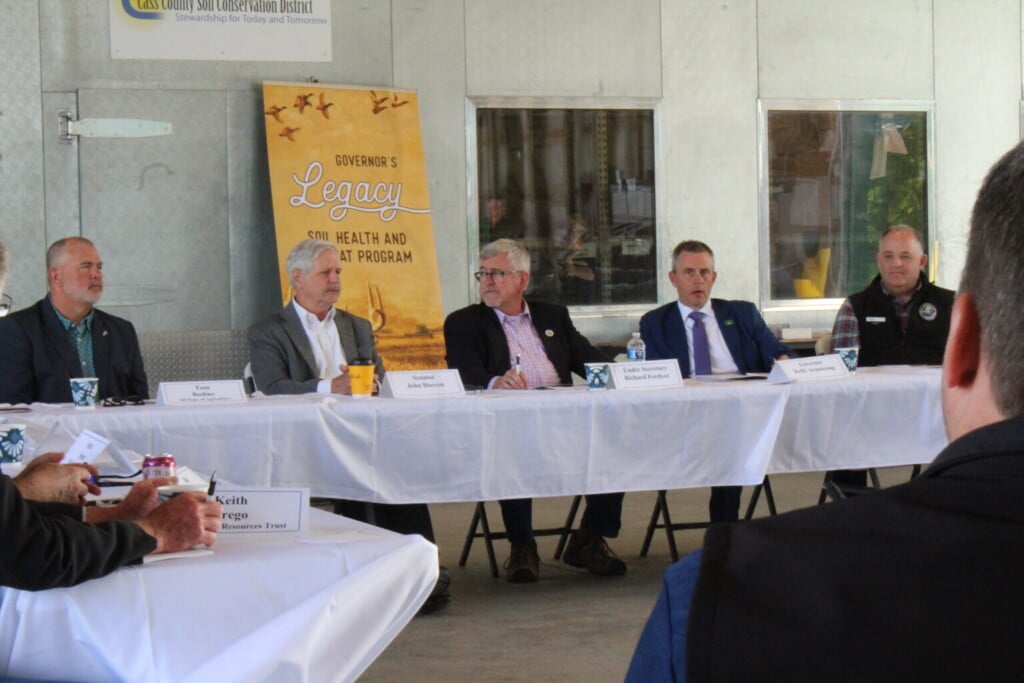
At a roundtable discussion in Mapleton on Wednesday, U.S. Sen. John Hoeven, R-N.D., lauded the program and said he had talked with North Dakota Gov. Kelly Armstrong about creating a partnership to support it.
“What we’re looking at is CSP, the Conservation Stewardship Program … we want to make $100 million of that eligible, on an annual basis, for a match for this kind of program,” Hoeven said at the roundtable.
Also at the roundtable was Richard Fordyce, USDA under secretary for farm production and conservation. He told the roundtable that “if there is an opportunity for some federal funding, obviously we, at the federal level, will do what we can to make sure that moves forward and gets where it needs to.”
The state program, which accepted applications in February and March, is being piloted this year. Its goal was to enroll 10,000 acres, but it received applications from almost 460 landowners looking to sign up a collective 20,000 acres. The remaining land was turned away due to lack of funds.
The program has been championed by Armstrong, who called it “a win for landowners, a win for sportsmen, a win for anybody who cares about pheasants and ducks and deer and everything in between.”
When they signed up for the program, landowners could also opt to sign their new grasslands up for the Private Lands Open to Sportsmen program, or PLOTS, which opens up private lands to hunters. Almost 6,000 acres of land currently enrolled in the program are also enrolled in PLOTS. Armstrong, a hunter himself, called hunting “part of North Dakota’s heritage” and “a workforce recruitment tool.”
“(Within) 100 miles of Bismarck, I can catch my limit of walleyes. I can shoot unlimited ducks. I can shoot unlimited dark geese. I can shoot unlimited light geese. I can pheasant hunt, I can partridge hunt and I can grouse hunt. I can shoot mule deer, I can shoot whitetail, I can shoot antelope,” Armstrong said. “If that’s the stuff you like to do, we are the best place in the world to go.”
The program is also helpful for conservation, because in a state like North Dakota — where more than 93% of land is privately owned — meaningful conservation efforts require cooperation from private landowners, Armstrong said.

Brian Roach, a retired farmer who lives near Wheatland, N.D., shows a map of his farm, including a 35-acre section that he enrolled in the Governor’s Legacy Soil Health and Habitat Program, during an event on May 27, 2026. Roach said hopes the program will help to strengthen the soil and make it farmable in the future. (Ceilidh Kern/For the North Dakota Monitor)
For landowners, the program offers a way to make money from less productive land. Owners will plant and grow grasses for five years, earning the average county rental rate for every acre.
Roach, the retired Wheatland farmer, rents his land to a young farmer who grows corn, soybeans, wheat and alfalfa. Once they plant grass seed on the 35 acres in the fall, the state will start paying Roach $150 an acre in rent per year.
“I wasn’t charging (my tenant) $150 an acre rent because that land isn’t that productive, but in five years, if this grass grows, it should become $150 an acre,” Roach said. “In effect, the state is subsidizing it to make it more productive land. That’s why it’s a win-win program.”
Another part of Roach’s farm is enrolled in USDA’s Conservation Reserve Program, which also pays landowners to convert less productive acreage to vegetative cover. While the two programs are similar, Roach said he preferred the state’s.
“It’s a super good program versus the (federal) government CRP program that’s about 15 pages of sign-up. This is one page. It’s simple,” he said, referring to the application.
Beyond how easy it is to apply, a key difference between the two programs is the extent of land being taken out of agricultural production, Armstrong said.
“CRP, a lot of times, is a full quarter or even a full section — 160 acres into grass, 640 acres into grass. (Our program) is those 32 acres in a quarter between two sloughs,” he said. “It’s designed to be smaller, edge acreage, where the wildlife likes to hang out and the farmer’s not making any money on it anyway.”
With the pilot program’s $6.5 million budget already allocated, Armstrong said he’s brainstorming ways to fund an expanded version for future years.
“If you want to scale this up, it’s going to be not an insignificant expense,” he said. “We could spend 100% of whatever the Legislature reasonably appropriated to it. If they wanted to give me $20 million, we could go spend $20 million. If they wanted to give $30 million to this a biennium, we could spend $30 million.”
“I don’t expect that, but I expect to figure out a way to grow this to a point where it’s so popular, they want to fund it,” he added.
While federal funds aren’t yet earmarked for the program, Armstrong said he was optimistic they would be. However, he said he doesn’t want the program to be entirely dependent on federal funding, “because I don’t want the program to go away because of an administration change.”
He said he also doesn’t want federal funding to change how the program is run.
“The only caveat I would have with federal funding for this program is, I’m not taking federal oversight. I would turn down the federal money if it came with federal regulation. This has to be flexible, and I have to be able to do it,” he said. “We have to be able to work with our landowners in real time.”
Article written by North Dakota Monitor reporter Ceilidh Kern.