Jerusalem under fire as Trump says fighting in Iran could last ‘4 weeks or so’
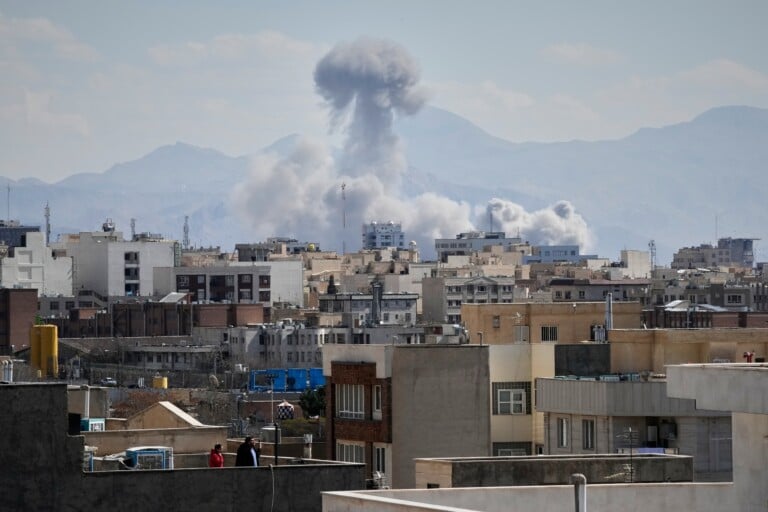
U.S.-Israeli strikes on Iran continued for a second day on Sunday after the killing of Iranian Supreme Leader Ayatollah Ali Khamenei threw the future of the Islamic Republic into uncertainty and raised the risk of regional instability.
There were explosions in Tehran on Sunday night as Israel said it was taking its attacks to the “heart” of Iran’s capital.
Iran retaliated by firing missiles and drones at Israel and at U.S. military installations around the Gulf, and also at the Saudi capital and the global business hub of Dubai. Earlier Sunday, Iran selected a 66-year-old cleric to join the three-member leadership council that will govern the country until a new supreme leader is selected.
A senior White House official says that “new potential leadership” in Iran has suggested they are open for talks with the United States. The official, speaking on condition of anonymity to discuss internal administration deliberations, said President Donald Trump says he is “eventually” willing to talk, but for now the military operation “continues unabated.”
Trump told The Atlantic in an interview on Sunday that he planned to speak with Iran’s new leadership. “They want to talk, and I have agreed to talk, so I will be talking to them,” he said, declining to comment on the timing.
Here is the latest:
Missile debris lightly injures 4 in Syria
Iranian missile debris lightly injured four people, including three children, in the town of Ain Terma in the Damascus countryside on Sunday evening, Syria’s state news agency SANA said.
The injured, a father and his three daughters, were transferred to a hospital, SANA said, citing the director of Ambulance and Emergency at the Health Ministry. It added that their injuries were minor and treated immediately.
6 Gulf states ask Iran to halt attacks on their territories
Top diplomats of six Gulf states called on Iran to immediately halt its attacks on their territories which they said violated their sovereignty and threatened to undermine regional security and stability.
The foreign ministers of Qatar, Saudi Arabia, the United Arab Emirates, Kuwait, Oman, Bahrain had a virtual emergency meeting Sunday following the U.S-Israel strikes on Iran that triggered Iranian barrage of missiles on U.S bases and other civilian infrastructure, including airports, hotels and in some cases, residential areas. The foreign ministers condemned the attacks they said targeted their territories and Jordan.
The Gulf top diplomats said their countries retain “their legal right to respond and the right to self-defense,” according to international laws.
Starmer says UK will not join strikes on Iran
Prime Minister Keir Starmer said the U.K. will not join in strikes on Iran but has agreed to let the U.S. use British bases for attacks on Iran’s missiles and their launch sites.
Starmer said Sunday that Iran was striking at British and its allies’ interests, and “the only way to stop the threat is to destroy the missiles at source.”
Britain had previously refused to allow the United States to use U.K. bases to attack Iran.
Starmer said Sunday he was authorizing their use because of the threat from Iran’s attacks on countries across the region. He said “we are not joining these strikes but we will continue with our defensive actions in the region.”
Starmer said Royal Air Force jets have intercepted Iranian strikes as part of defensive operations in the region.
Trump says US service members killed will be avenged
U.S. President Donald Trump said of U.S. service members killed that America will ’avenge their deaths.”
The president made the comments in a roughly six minute video he posted on social media Sunday afternoon. He called the three service members “true American patriots who have made the ultimate sacrifice for our nation, even as we continue the righteous mission for which they gave their lives.”
The president went on and added: “Sadly, there will likely be more, before it ends. That’s the way it is. Likely be more.”
State Department travel advisory for Qatar, Bahrain
The State Department is allowing non-essential U.S. diplomats and families of all government personnel to leave Bahrain and Qatar as U.S. and Israeli strikes on Iran and Iranian retaliation continue.
In updated travel advisories issued on Sunday, the department said it had moved to reduce its diplomatic footprint in Doha and Manama “due to security concerns.”
It added that private American citizens should “reconsider travel to Bahrain and Qatar due to the threat of armed conflict.”
Near-perfect conditions for Israel-US strike, official says
An Israeli military official says a variety of factors created near-perfect conditions for Israel and the U.S. to kill much of Iran’s leadership in the opening strike of the war.
The official says that months of planning and close coordination with the U.S., combined with real-time intelligence that the targets were gathered together, allowed the two allies to strike in the joint operation on Saturday morning.
The official says the airstrikes targeted three locations, all within 60 seconds of one another, killing Iran’s supreme leader and some 40 senior officials, including the head of Iran’s Revolutionary Guard. He said that striking in broad daylight added an additional element of surprise.
The official said Israel and the U.S. agreed that striking the leadership was the best way to open the operation. Otherwise, he said they would quickly disperse and go into hiding once the attacks began. He spoke on condition of anonymity to discuss the covert operation.
“We had a great opportunity, great intel, great execution,” he said.
By Josef Federman
Israel’s top general praises military’s early gains
Israel’s top general praised his military’s early gains in fighting with Iran, while warning the public that “many more days of combat lie ahead.”
After a day marked by warning sirens, strikes and at least nine deaths from one Iranian attack, Lt. Gen. Eyal Zamir mourned fatalities in the town of Beit Shemesh and hailed “significant achievements” that he said Israel and the U.S. had made thus far. The two countries’ strikes on Iran took out high ranking security officials and Supreme Leader Supreme Leader Ayatollah Ali Khamenei.
“Patience and resilience are required now. We are operating in close cooperation with our ally. Coordination with the U.S. military is closer than ever,” Zamir, the army’s chief of the general staff, said.
Iran fight could go on for ‘4 weeks or so’
U.S. President Donald Trump has discussed a timeline for the fighting in Iran during a phone interview with a British newspaper.
“We figured it will be four weeks or so,” Trump told the Daily Mail. “It’s always been about a four-week process, so, as strong as it is — it’s a big country — it’ll take four weeks, or less.”
The U.S. military said three service members have been killed, the first known American casualties from the conflict. Trump called those killed “great people.”
“You know, we expect that to happen, unfortunately,” Trump told the newspaper. “Could happen continuous — it could happen again.”