Minnesota lawmakers seek to regulate artificial intelligence
ST. PAUL, Minn. (Minnesota Reformer) — A bipartisan group of Minnesota lawmakers are hoping to limit how the artificial intelligence industry operates in the state, arguing that it’s evolving in ways that are harmful and unconstitutional.
Minnesota senators on Monday considered five measures to regulate AI, including a bill (SF 1857) stating that companies that create AI chatbots — like ChatGPT — ensure minors do not access them, and a bill (SF 1886) requiring that companies disclose when a person is communicating with AI.
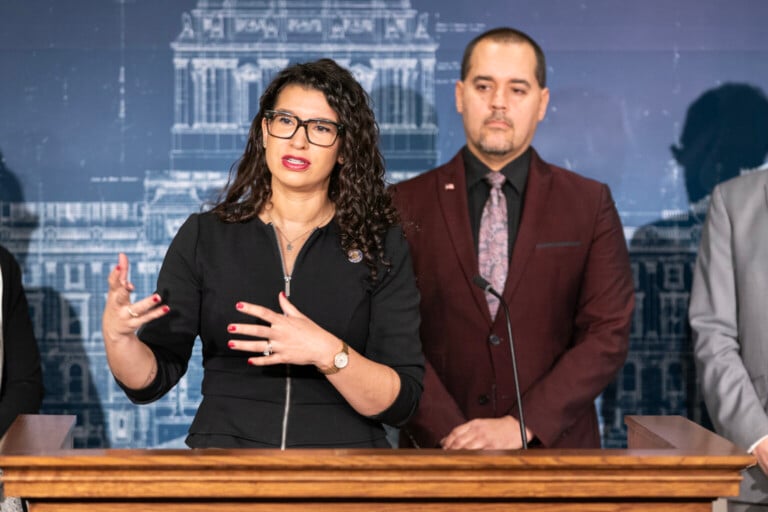
Sens. Erin Maye Quade, DFL-Apple Valley, and Eric Lucero, R-St. Michael, are leading the bipartisan effort to regulate AI. The duo — who are on opposite sides of the political spectrum — said they aren’t opposed to the technology but urged lawmakers to protect Minnesotans. Maye Quade and Lucero were co-authors of a bill regulating deepfakes — digitally altered photos or videos depicting events that didn’t actually happen — which became law in 2023.
“There’s a recognition that we need to do something to bring controls in place, to uphold the Constitution, to protect privacy and to empower individuals against these multi-billion dollar industries,” said Lucero, who works in cybersecurity, on Monday.
One of Maye Quade and Lucero’s bills (SF 1120) would prohibit the government from requesting reverse-location data, which many law enforcement agencies use when they do not know who specifically committed a crime.
Law enforcement can obtain a warrant that mandates a technology company give them data about which cell phones were in a certain location at a specific time or who has searched for a specific word or phrase on their phones or on an AI chatbot.
Civil liberties advocates argue warrants are supposed to be narrow, and these so-called “reverse warrants” allow the government to conduct widespread surveillance on everyone who was in an area at a given time or on people who are searching for words or phrases. This is a violation of the Fourth Amendment, advocates argue.
Law enforcement officials, including the Minnesota Bureau of Criminal Apprehension, testified against the bill, arguing that it would harm public safety.
“While I certainly appreciate Sen. Maye Quade’s intentions to protect individuals’ privacy rights with such technological capabilities, prohibiting this critical investigative tool would have extensive negative consequences in local and state investigations,” BCA Superintendent Drew Evans stated in written testimony. “It would impact the ability for law enforcement to prevent and solve crimes and to hold individuals accountable.”
A growing number of states are seeking to regulate AI, as more companies seek to capitalize on the technology. Last year, 38 states adopted or enacted around 100 AI-related measures, according to the National Conference of State Legislatures.
But the federal government has sought to curb states’ ability to regulate AI, as companies are furiously lobbying Congress and the White House to get rid of state regulations. Lawmakers last summer attempted to include a 10-year moratorium on state AI laws in the One Big Beautiful Bill Act, but the Senate dropped it.
President Donald Trump in December signed an executive order giving the attorney general the ability to sue states and overturn laws that don’t support the “United States’ global AI dominance.”
Maye Quade said that minors should be prohibited from accessing AI chatbots because the machine could introduce virtually any topic including disturbing content.
Maye Quade said she’s been talking to AI companies about the regulations and believes they could reach a compromise, but she said she’s okay if they oppose the bills.
Maye Quade said that states shouldn’t back down from trying to regulate AI.
“For decades, tech companies have told legislators and the public that damage and destruction from their unregulated products are necessary byproducts of growth and innovation. They have told us that they can do amazing things, like cure cancer, but not comply with 50 different laws in states. We can no longer accept that narrative,” Maye Quade said.
(Story written by Michelle Griffith – Minnesota Reformer)