Group to fund pilot projects to make North Dakota ‘healthiest state in the nation’
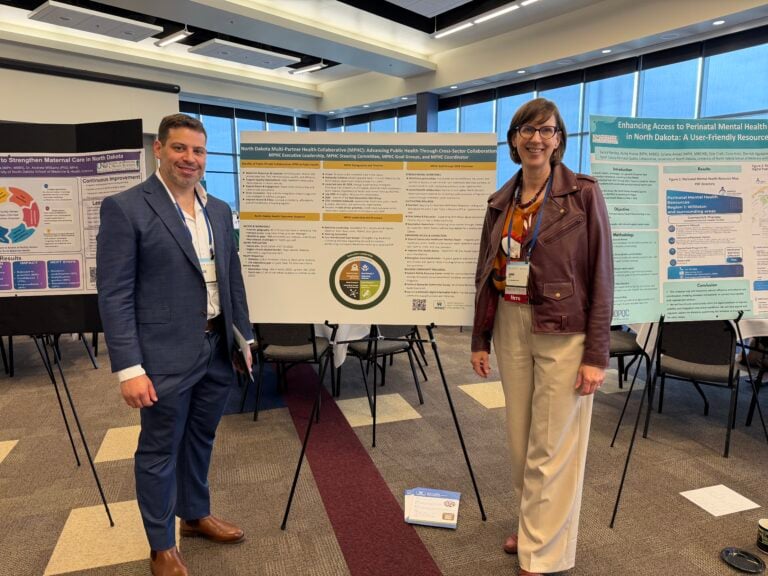
BISMARCK, N.D. (North Dakota Monitor) – A statewide health collaborative has begun announcing funding for new pilot projects focused on tackling North Dakota’s health challenges.
On Friday, the group announced it awarded $10,000 for its first project, an effort to identify and map family support programs, services and resources across the state. That information will be used to help the collaborative understand strengths and gaps in those services and lay the groundwork for future projects to improve care, according to a statement to the Monitor.
The pilot projects, set to be announced throughout June and July, will be run by some of the collaborative’s member organizations, which include state agencies, local governments, healthcare providers, tribal nations, businesses and other groups from across the state.
This is the first year the Multi-Partner Health Collaborative — the only multidisciplinary, statewide collaborative of its kind in the country— will be funding pilot projects.
The collaborative was created in 2024 with the goal of making North Dakota “the healthiest state in the nation” by fostering dialogue and cooperation among members and finding ways to implement the state’s five-year State Health Improvement Plan.
The plan runs through 2029 and identifies four public health priority areas: strengthening workforce, cultivating wellness, expanding access and connection, and building community resilience.
One of the group’s goals is to reduce redundancy from different organizations testing the same solutions and help those organizations spend their limited dollars more efficiently, according to Megan Langley, executive director of Strengthen ND, a rural development group and one of the collaborative’s four “pillar” organizations.
“The fact is, if we want to make big impacts on folks here in North Dakota, we’re going to need to work together as groups or organizations to leverage or maximize the type of funding that is available,” Langley said.
The group’s first two years were spent bringing in more stakeholders, building goal groups — smaller groups within the collaborative that each focus on one of the state’s priorities — and talking with group members about the issues they see in their communities and how they might be addressed.
For the Building Community Resilience goal group, one issue members have honed in on is the need to bridge gaps between existing programs and resources, according to Katie Leitch, the group’s chair and a planning specialist at the North Dakota Department of Emergency Services.
“Services can sometimes operate in parallel rather than in partnership,” Leitch said. “From a community perspective, that can look like confusion, barriers to access, or difficulty in knowing where to start. Our goal group has really been working on how to better connect what already exists while also identifying and addressing gaps.”
One area they’ve focused on is supporting families, potentially through family resource centers, centralized hubs — either in person or online — for resources and services for things like parenting skills, child development and economic stability, Leitch said.
“They have strong outcomes nationally, including reductions to child abuse and neglect (and) improvements in family stability,” she said. “Roughly 42 states have implemented the Family Resource Center model, so we’re exploring how and where that could be integrated into North Dakota.”
Leitch’s group will help lead the new effort to map the state’s family support programs. With the information they gather, the collaborative hopes to “lay the groundwork for future Family Resource Center development,” Langley told the Monitor in an email.
The family services mapping project received $10,000 from a $52,000 pot, part of a $150,000 grant that the collaborative received from the Common Health Coalition earlier this year. The rest of that $52,000 will be divided among the collaborative’s other goal groups, which are expected to present their own pilot projects this and next month.
Tony Burke, one of the group’s founders and the American Heart Association’s head of government relations for the Dakotas and Nebraska, said the projects could take many forms.
Besides mapping family support resources, he said a hypothetical pilot project could test strategies for combating cardiovascular disease, which is “the No. 1 killer in North Dakota and has been for a long, long time,” he said.
“It could be related to physical activity,” Burke said. “It could be related to nutrition access. It could be related to mental health and wellbeing services … an easy one could be a new way to curb or restrict vape products or tobacco usage.”
The pilot projects are expected to finish around the end of the year. Once they’re completed, groups will begin sharing lessons learned and exploring ways to scale approaches that worked, Burke said.
“We might have one great pilot (and) say, ‘OK, now how do we take this to scale? What does this look like across five communities, 10 communities, 20 communities?’” he said. “‘What policies have to be looked at to be able to do so?’”
Langley said the collaborative is hoping to engage with state lawmakers during next year’s legislative session.
As for what the collaborative’s founders and members want it to look like in the long term, Burke said the group’s next phase is still in development, but he pointed to a similar group in Texas as a potential model.
The Houston-based Coalition for Connected Care started in 2018 to bring together the city’s stakeholders and address non-medical drivers of health, like access to food and housing. Burke said the two groups have had several meetings to talk about their work and the evolution of their organizations.
Several years in, the Houston coalition has made screenings and referrals “the norm” in the city, according to Shreela Sharma, one of the group’s leaders. And when the group realized there were sometimes rough transitions between getting a referral and accessing resources, it built an online network where the city’s health systems can refer patients to services all under one umbrella.
“(We) had no intention of being in this space of developing technology solutions, but it was a problem that existed between all of these organizations in a space that nobody could conceivably enter,” Sharma said. “So … we came together, all the different organizations, (and) developed the solution.”