North Dakota Highway Patrol wants lawmakers to report harassment because ‘threats precede violence’
BISMARCK, N.D. (North Dakota Monitor) — Every morning before 9 a.m., Sen. Judy Lee receives a call on her landline, the only phone number she discloses publicly.
Lee never picks up. She doesn’t know who it is that keeps calling. It could be harassment. Or it might be a telemarketer.
“I doubt that it’s somebody who wants to shoot me,” said Lee, R-West Fargo. “They could just come to my door. They’ve got my address.”
The availability of elected officials’ home addresses has become a concern as North Dakota looks for ways to balance transparency and accessibility against personal security. North Dakota lawmakers’ home addresses were removed from the Legislature’s official website last summer in the wake of the shootings of two Minnesota legislators at their homes.
But the addresses are often available elsewhere, online or in public documents, due to requirements in state law. That was particularly noticeable this month as lawmakers file campaign finance and financial disclosure reports.
“You’re filling all that out, which is all public. But there was no suggestion made that maybe, rather than this address, use a PO box,” said Sen. Greg Kessel, R-Belfield, during a security briefing last month.
Deputy Secretary of State Sandy McMerty said state law requires residential addresses to be disclosed on some forms, but elected officials often have the option to provide an alternative mailing address, such as a post office box, that will be visible to the public instead.
The post office box or other alternate address can then be provided when filing campaign finance reports and financial disclosures, called statements of interests in North Dakota.
A candidate’s residential address will still have to be submitted so the Secretary of State’s Office can verify the candidate lives in the district they are running for office in. But candidates can opt to have only the mailing address visible to the public.
Addresses are also visible online when somebody makes a campaign contribution, based on what address is on the contributor’s check. McMerty said elected officials contributing to somebody else’s campaign can obtain a separate address for campaign purposes and ensure that address appears on their checks if they wish to avoid disclosing their home address.
People who sign petitions to support candidates or ballot measures also are required to provide residential addresses, McMerty said.
Lee has thus far declined to obtain a post office box for use on public filings and said she has no intent to do so. But recent events have prompted her to think more about security for herself and her colleagues.
“The idea that we should have to feel threatened is so disgusting to everybody, every normal person,” Lee said. “You shouldn’t have to worry about children on their way to school. You shouldn’t have to worry about your partner or your spouse being in danger somewhere.”
The requirement to disclose addresses on certain filings is in state law. McMerty said the secretary of state, Michael Howe, is prepared to work with legislators during the 2027 legislative session to make changes in the interest of security.
“There’s a lot of things surrounding elections that require that residential address because it’s verification that you’re running in the district you’re supposed to,” McMerty said. “Secretary Howe stands ready to work with the Legislature in any way to best protect elected officials in that capacity. But there are some elements where those residential addresses are required currently.”
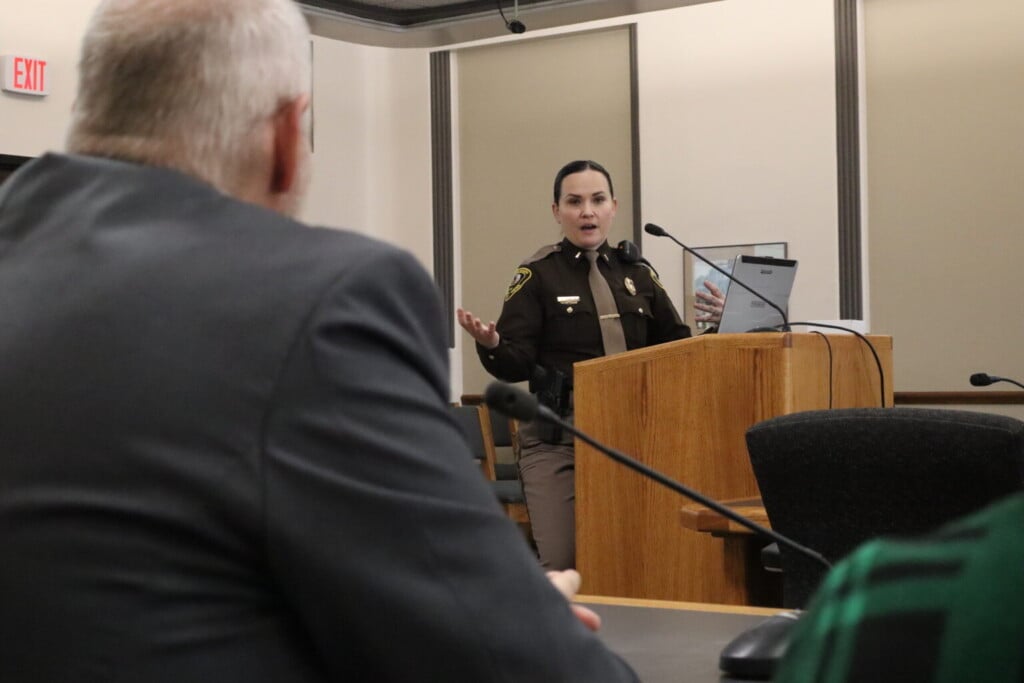
Lt. Jenna Clawson Huibregtse and Sgt. Darcy Aberle of the North Dakota Highway Patrol cautioned during a recent safety presentation that addresses and other personal information are easily found through online search engines.
“We just can’t ever assume that our personal information is really that private,” Clawson Huibregtse said.
‘Threats precede violence’
North Dakota Highway Patrol, the law enforcement agency responsible for the security of North Dakota’s Capitol, has observed an increasing frequency of threats and harassment against lawmakers, state employees, and statewide elected officials like the governor in recent years.
Lawmakers are encouraged to report any behavior they find concerning so the Highway Patrol can open a case file, observe patterns and identify potential threats before they reach these later stages.
“We want to know even about the small stuff,” Aberle said.
The threats and harassment elected officials receive can sometimes be an early indication of future political violence, said Clawson Huibregtse.
“Threats precede violence. Not all threats become violent, but we need to know about things early because we know that those threats happen before violence,” she said. “People don’t just all of a sudden become violent one day.”
That doesn’t mean all behavior lawmakers find concerning will constitute a crime like harassment.
“You guys have to have thick skin, like us,” Clawson Huibregtse said of elected officials. “People can be angry. Angry is not illegal. It’s uncomfortable, but it’s not illegal. Advocacy is just emotional.”
North Dakota Monitor reporter Jacob Orledge can be reached at jorledge@northdakotamonitor.com.