Federal cuts would be ‘death knell’ for North Dakota tribal colleges, campus presidents say
FARGO, N.D. (North Dakota Monitor) — The Trump administration has proposed cutting all federal funding for tribal colleges and universities, the second time in two years it has sought major funding cuts for the institutions.
In its fiscal year 2027 budget request, the Department of the Interior proposed cutting more than $150 million from tribal colleges and universities and tribal postsecondary programs.
That’s more than last year’s proposal to cut $105 million. In fiscal year 2025, tribal colleges received a total of $196 million from the federal government.
Congress rejected last year’s proposed cuts, and the Department of Education later announced it was redistributing additional funds to tribal colleges and universities and historically Black colleges and universities. That extra money came primarily from other institutions serving minority students.
Despite the win in Congress and the additional funding, tribal college leaders in North Dakota began looking for ways to minimize spending last year, according to previous Monitor reporting.
Even with those savings, Twyla Baker, president of Nueta Hidatsa Sahnish College in New Town, said that, if approved by Congress, the newest proposal would be “devastating.”
“I can guarantee there would be TCUs that would be shutting down within a year to two years, and that it would be … the death knell for our institutions,” Baker said.
Nueta Hidatsa Sahnish College gets more than 50% of its funding from the federal government. Without it, Baker said the school would be able to keep its doors open “three, four years tops, and that would be with extreme budgeting across the board.”

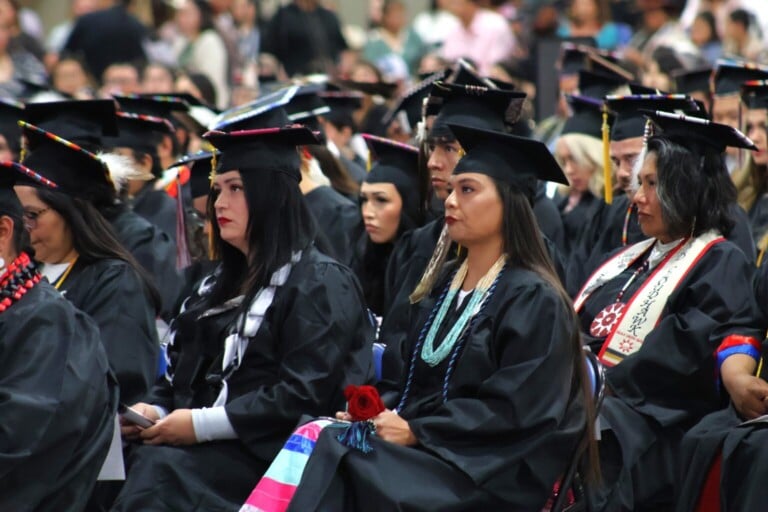
Russ McDonald, president of United Tribes Technical College, speaks to graduates during the 2026 spring commencement ceremony at the Bismarck Event Center on May 8, 2026. (Photo by Michael Achterling/North Dakota Monitor)
United Tribes Technical College in Bismarck gets around 70% of its funding from the federal government, according to Russ McDonald, the college’s president.
If that funding were to go away, “It’ll close us. We’ll close the doors,” McDonald said.
“I mean, there’s some reserves that we have that would just carry us to close,” he added. “We might last a year.”
In a statement opposing the cuts, the American Indian Higher Education Consortium argued that tribal colleges and universities “serve as essential education, workforce, and economic anchors in some of the most rural and underserved regions of the country.”
“Eliminating TCU funding does not represent meaningful federal savings; it removes a relatively small investment that delivers outsized economic and community impact,” the statement read.
A study from the North Dakota Tribal College System found that from 2022 to 2023, tribal colleges added $169.5 million to North Dakota’s economy, the equivalent of supporting 2,106 jobs.
The proposed federal cuts come after decades of underfunding for tribal colleges nationwide. A 2024 ProPublica investigation found that Congress was underfunding tribal colleges by $250 million per year and that the Bureau of Indian Education had never asked lawmakers to fully fund tribal colleges and universities at the level required by federal law.
In North Dakota, underfunding has forced campuses to make difficult budget decisions. As a result, competitive pay and facility maintenance have sometimes been put on the backburner, McDonald said.
“If we were fully funded at the same levels as our state counterparts here in North Dakota, or on the federal level, like historically Black colleges and universities, then I think we’d be in a better position to provide those facilities that would enhance learning and the experience of students here on our campuses,” he said.
Baker said her college and others have had to get creative about finding other revenue.
“We’re constantly chasing money to make up for the gap that’s been created by the lack of federal dollars … but it shouldn’t have to be this way,” Baker said.
Asked what full funding would mean for TCUs, Baker said she “can only dream of a day like that.”
“We are so good at generating growth, generating economic development in our smaller communities and preparing our students for other institutions or the workforce,” she said. “Everything this administration says they want, we’re doing that on our campuses. If we were to have additional dollars, I can only imagine what we would be able to do.”

Sunni Dupris, of Eagle Butte, S.D., is directed off stage after receiving an associate’s degree in business administration while holding her son, Grant, during the 2026 United Tribes Technical College spring commencement ceremony at the Bismarck Event Center on May 8, 2026. (Photo by Michael Achterling/North Dakota Monitor)
Tribal colleges can sometimes support students better than other universities, said Cynthia Lindquist, former president of Cankdeska Cikana Community College and former director of Tribal Initiatives and Collaborations for the University of North Dakota.
Thanks to smaller class sizes and more direct interaction, faculty can connect students with childcare, transportation and technology resources to help them succeed, Lindquist said.
While tribal colleges don’t exclusively serve Native American students, Lindquist said “there’s a strong cultural component” to their value.
“As tribal college students and as Native people, it’s also the reinforcement of identity, the strengthening of identity, (the reminder) that we have much to be proud of,” she said. “We have been contributors all along as this country was colonized. And that education complements that confidence.”
Through treaties and other agreements with tribal nations, the U.S. government committed itself to upholding certain trust responsibilities, including supporting education for tribal citizens.
Congress has since passed several laws to codify that commitment, including laws authorizing the creation of tribal colleges. Those laws guaranteed tribal colleges $8,000 in funding per student per year, with adjustments for inflation.
“There are agreements in place from well before this administration was ever in existence that these structures were to remain in place,” Baker said. “We prepaid with the land that this country occupies, and this is just a complete and utter reneging on that agreement.”
As budget hearings and negotiations continue on Capitol Hill, McDonald said he is “confident that Congress will once again support us in the work that we’re doing.”
While he hasn’t talked to North Dakota’s congressional delegation about this particular proposal, McDonald said they indicated their support for tribal colleges when he visited them in Washington, D.C., earlier this year.
In a statement to the Monitor, Sen. John Hoeven, R-N.D., wrote: “We provided strong funding for North Dakota’s tribal colleges and universities this year, and I expect we will continue to fund them again in the coming year.”
Rep. Julie Fedorchak, also a Republican, said the president’s budget is a starting point and she plans to review priorities that matter to North Dakota communities, including tribal colleges.
In the meantime, Lindquist said “people are ready and mobilized, including our students, who are the best advocates to speak about it and their experiences at the tribal colleges.”
(Story written by Ceilidh Kern – North Dakota Monitor)