Regional initiative builds rural housing to drive growth
LAKOTA, N.D. (North Dakota Monitor) — Available housing is so scarce in Lakota, North Dakota, that people call city officials to ask for leads.
“We get calls all the time about housing availability, rentals, ownership,” said Amie Vasichek, city auditor for the town of almost 700.
In Hoople, a town of around 200 an hour north of Lakota, officials also field calls from interested buyers, who try going straight to residents, as well.
“We’ve even had people that are driving through town and see locals walking around stop and ask if they know of any houses for sale,” said Peyton Cole-Markel, a Hoople City Council member.
Housing supply growth has been sluggish or nonexistent in many rural North Dakota towns despite growing demand, according to Lisa Rotvold, executive director of the Red River Community Housing Development Organization.
“There are many, many jobs in these rural communities that go unfilled because there’s no place for people to live,” Rotvold said. “The jobs are there; we need the people.”
A 2022 task force identified a number of barriers to new construction in rural areas, including challenges accessing financing, a shortage of contractors and a shortage of buildable lots.
Another challenge is “appraisal gaps.” Towns with no new construction for several years may lack appropriate comparable sales, or “comps,” for lenders to use when appraising the value of a newly built home. That means houses can be appraised at below the cost of construction, forcing contractors to cover the difference out of their own pockets.

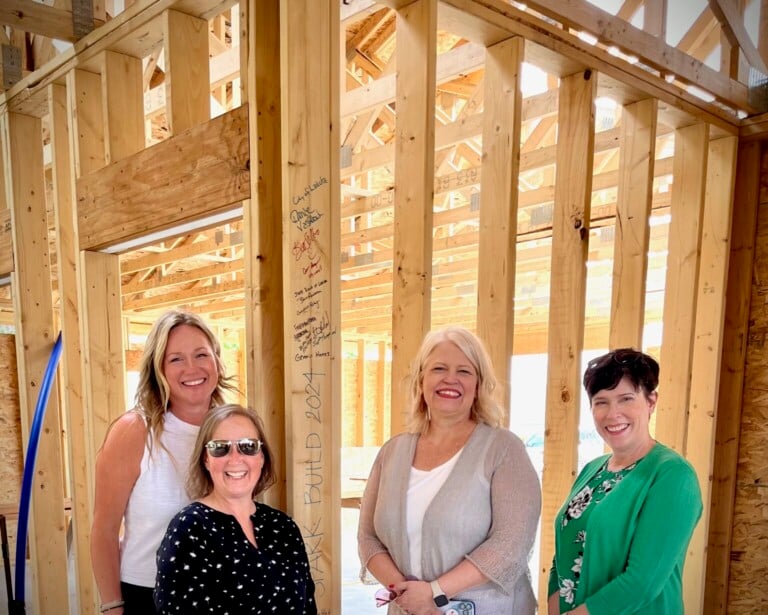
Stakeholders TK tour a home under construction in Lakota, N.D., in the summer of 2024. (Photo courtesy of Amie Vasichek)
In response to these challenges, members of the task force pushed to allow the state-run Housing Incentive Fund — previously reserved for multi-family housing — to be used for single-family housing, too.
That effort inspired the Spark Building Initiative in 2024. Run by the Red River Community Housing Development Organization, the initiative aims to “take the risk off of the builder, off of the community, off of the lender, by serving as the developer,” Rotvold said.
Using funds from the Housing Incentive Fund and local lenders, the initiative contracts directly with builders to construct homes on lots donated by towns with fewer than 5,000 residents. It also helps to sell those houses and covers any appraisal gaps.
“One of our objectives is (to) build a small number of homes every year on a continuing basis so that we’re creating comps, we’re spreading them around the region, and we’re investing in rural communities and meeting those needs,” Rotvold said.
“Hopefully there’s others that jump into it and see that there is demand for new for-sale housing in rural places, and they join in and start developing, too,” she added.
So far, the initiative has built two homes in Lakota and two in Larimore. Five are under construction in Park River and Grafton, with six more planned in Minto, Michigan and Hoople.
All of the completed homes, including the two in Lakota, sold before crews finished construction.
“That was exciting,” Vasichek said. “It really proved that we have a real market for housing here.”
Those sales created a “ripple effect” in Lakota, opening up existing homes and apartments for current residents and newcomers alike, Vasichek said, adding that she hopes the new homes will help local employers fill their roughly 10-20 open positions.
In Hoople, crews will break ground on the town’s first Spark Building lots later this year. Cole-Markel said she hopes additional housing will help fill current job openings in the community, but also help with “sparking further jobs.”
Despite strong demand, the initiative doesn’t address another major barrier: affordability. The initiative’s first two houses sold for around $325,000, Rotvold said, while the more recent pair sold for around $355,000.
“For a lower-income household, that’s still probably out of reach,” Rotvold said.
Vasichek and Cole-Markel said demand for affordable housing exceeds supply in Lakota and Hoople, where the few apartment units are constantly full.
Rotvold said she’s exploring alternatives to target households that earn the area median income or below.
“We would continue to play the role as the developer and arrange for financing and construction and selling of the homes, but we would be trying to add a component that would help with down payment assistance and things like that,” she added.
Cole-Markel said an affordable housing program would be “wildly popular” in Hoople, as well as other small towns across the region.
“A lot of other towns want to have this new development, (but) they’re afraid of the risk that those homes won’t sell,” she said.
Another challenge is the limited supply of lots that don’t require significant investment to get connected to utility infrastructure. Rotvold said she and others have been pushing state lawmakers to help fill the gap.
Legislators in 2025 came close to approving one-time funding for grants to support infrastructure for rural housing. But the bill narrowly failed after the two chambers could not agree on how much money to appropriate, Rotvold said.
As Lakota begins to run out of buildable lots, Vasichek called state support “a make-it-or-break-it funding source for our small communities.”
Rotvold said she believes the funding will come up again during the 2027 session, adding that towns should develop plans now to strengthen their case.
The North Dakota Department of Commerce recently awarded the Spark Build Initiative nearly $150,000 in workforce grant funding, which it used to hire a project manager.
In Hoople and Lakota, Cole-Markel and Vasichek said residents are excited about the initiative and constantly ask when homes will be completed and when more will be built.
As Lakota prepares to break ground on a new twin home this summer, “we already have people interested,” Vasichek said.
While the initiative aims to inspire developers and contractors to invest in rural communities on their own, Rotvold said it’s unclear how long the initiative will operate.
“We are searching for other solutions that could help builders become more independent so that we don’t need to be filling this role,” she said, adding that rural areas lack the urban housing “machine” that can produce homes more efficiently and affordably.
Still, she said early results show progress. Appraisal gaps on initiative homes have shrunk from $30,000 for the first round of houses to $15,000 and $7,000 for the second and third rounds, respectively.
“I feel really good about that — I actually really do think it’s possible to get rid of that appraisal gap,” Rotvold said. “I think we are achieving what we set out to do.”