How one Minnesota family is managing life after deportation
BURNSVILLE, Minn. (Minnesota Reformer) — These days, Blanca Lara feels like crying most of the time.
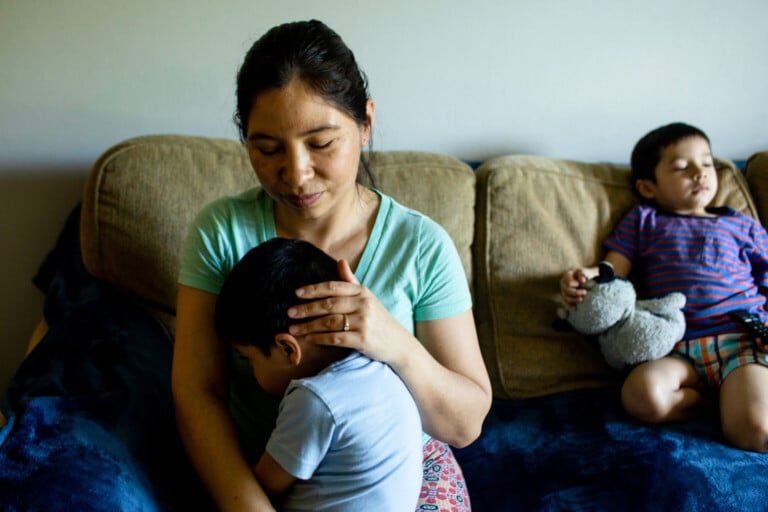
She struggles to sleep without her husband beside her. Her sons, 4 and 2, spend most of the day in front of the TV in their Burnsville apartment, glued to YouTube videos of men constructing houses in the jungle. In the kitchen, 42-year-old Lara makes pupusas for them, stuffing masa balls with beans or, on good days, shredded pork, then flattening them into ovals and toasting them on a griddle. Her younger son hasn’t been eating enough since his father, Hugo Diaz, was arrested by immigration authorities in January.
Diaz calls daily from his sister’s house in Guatemala, and video chats with his sons. The younger boy frequently cries out for his father. The older one sometimes refuses to talk, and falls silent for hours after seeing his father on Lara’s phone screen.
“He would only answer me with his head. It’s like his lips were glued together — like his head was spinning,” Lara said in Spanish. “For them, it’s like an abandonment.”
They are among the thousands of Minnesota families separated by the Trump administration’s mass deportation campaign, which culminated in Operation Metro Surge, in which thousands of immigration agents swarmed the state. Agents from Immigration and Customs Enforcement and Customs and Border Patrol arrested more than 3,700 immigrants, including hundreds of people with valid work permits or other permission to remain in the U.S. while their immigration cases were pending. The arrests left many families separated from loved ones who’ve been detained on their way to likely deportation.
The forced family separation is a feature, not a bug of the arrests. The Trump administration is creating various hardships for immigrants to nudge them into self-deportation. On the flip side, the administration is also offering free travel and a $2,600 “exit bonus” to those who voluntarily self-deport.
Diaz, 49, first arrived in the U.S. as a teenager, driving across the U.S.-Mexico border into California without encountering border agents. In Los Angeles, he met up with some Guatemalan friends who had been living in Minnesota, who told him the opportunities were better there. So he picked up and moved to the Twin Cities, settling in Burnsville, home to a vibrant Latino immigrant community.
He started a transportation company, carving out a niche driving people — particularly other Spanish-speaking immigrants — to medical appointments. He named the company Transportes Xelaju, after the Mayan language word for his hometown of Quetzaltenango, and built a reputation for safety and reliability. He hired drivers, and eventually started a side business cleaning homes and businesses.
In 2022, he got a call from a woman who needed a ride to a doctor’s appointment for her 6-month-old. Lara, recently arrived in the U.S. and separated from her child’s father, climbed into his backseat with her baby.
They fell in love. The following year, she moved into the Burnsville apartment with him, and they began referring to each other as husband and wife, though they never had a formal wedding. In 2024, Lara gave birth to Diaz’s son, Hugo Jr.
Both Diaz and Lara were undocumented, having arrived in the U.S. from Guatemala and El Salvador, respectively, without applying for legal status. They settled into their life as parents of young children. Lara stayed home with the boys most of the time, sometimes helping Diaz with cleaning jobs. She fed them well, having spent decades laboring in a pupusería in her home country of El Salvador, and prayed over her family.

Family photos line the walls in Lara and Diaz’s Burnsville apartment Wednesday, May 13, 2026. (Photo by Nicole Neri/Minnesota Reformer)
In early January, they started hearing rumors of immigration agents grabbing people off the streets, but continued their lives as normal. On Jan. 5, Lara said, the couple cleaned houses together.
The next day as he was preparing to leave for work, Diaz mentioned that he’d spotted some immigration agents, and Lara asked him to stay home. But he needed to work to support the family — he had rides scheduled, he responded before leaving the apartment.
Around noon, he was taking a mother and her 2-month-old infant to a medical appointment, driving north on County Road 11 in Burnsville, when immigration agents signaled for him to pull over. The agents knew his name, and that he was from Guatemala, Diaz said. They arrested him, leaving the car, the passenger and her baby on the side of the road.
The passenger called Lara to tell her Diaz had been arrested.
The agents brought Diaz first to the Whipple Federal Building, where ICE is headquartered in Minnesota. He spent three cold days and nights there, sleeping on a bench with a small blanket, with no access to a phone, he said.

The Bishop Henry Whipple Federal Building where many people detained by ICE, including Hugo Diaz, have been held. (Photo by Glen Stubbe/Minnesota Reformer)
Then officials shipped him on a plane to El Paso, Texas. Twice, he said, agents presented him with the option to sign some papers for voluntary removal, which they promised would get him out of detention quicker. He declined each time in hopes of defending himself from deportation in court. On his fourth day in El Paso, he was granted a brief phone call with Lara, and they spoke for the first time since his arrest. He told her he was being transferred to the Laredo Processing Center, a detention center operated by private prison company CoreCivic.
Shortly after that phone call, Lara took a pregnancy test at home. Two lines appeared on the screen. It was positive.
Family news, received in court
Diaz spent three months in the Laredo Processing Center, his stay punctuated with a handful of court hearings during which he and his attorney attempted to appeal the government’s decision to deport him. He remembers the dates clearly, because he was thinking about little else besides getting out of detention and reuniting with his pregnant wife and their children.
Undocumented immigrants have a handful of narrow pathways to stay in the U.S. One involves demonstrating to an immigration judge that the immigrant has lived in the U.S. for more than ten years; that they have good moral character; and that their removal would present “exceptional and extremely unusual” hardship to a U.S. citizen or legal permanent resident family member.
Diaz would have no problem clearing the first two hurdles, having lived in the U.S. for decades, with no criminal record and a documented history of starting businesses, creating jobs and paying taxes. And, Lara’s pregnancy presented a compelling case for the third bar — that his deportation would leave his pregnant wife and young children without an income. While Lara is undocumented, their youngest son — Hugo Jr. — is a citizen, born on American soil, and their forthcoming baby would be a citizen, too.
But even that argument faced long odds. The Trump administration has been purging immigration courts of judges who are sympathetic to such cases, and replacing them with magistrates who support the administration’s mass deportation agenda. Texas judges ordered nearly 99,000 deportations in 2025, a 44% increase over the prior year. By April of 2026, Texas immigration courts had facilitated more than 69,000 deportations — on pace to double the number of deportations last year.
On the advice of their attorney, Lara scheduled a doctor’s appointment to confirm the pregnancy, and request that the doctor write a letter to to support their case.
On Feb. 23, she laid on her back in a Burnsville OB-GYN’s office for an ultrasound. The doctor couldn’t detect a heartbeat.
In the courtroom for his final court appearance, Diaz listened as his attorney read the letter Lara’s doctor wrote on the day of her appointment:
“Today she had an early pregnancy ultrasound that unfortunately shows she has had a missed miscarriage at 9 weeks. For emotional support, she will need her spouse to get through this difficult situation.”
That was how he learned the child would never arrive.
The judge denied his appeal. Diaz would be deported.
On May 2, detention center staff removed Diaz from his room and handed him a bag with his belongings. He looked at the tag, and saw the word “Guatemala.” They were sending him back to the country he hadn’t seen in more than 20 years.
Separation
Outside his sister’s house in Quetzaltenango, Diaz’s nieces and nephews clamor for his attention while he’s on a video call. He gently urges them to go inside until his call is over.
“It was painful” to hear about the miscarriage in a courtroom, Diaz said from Guatemala, his face slack. “Well, more for her, because I knew she was going to struggle with the process of losing the baby.”
Lara opted to pass the miscarriage at home, and slid into a depression that still clouds her days. Diaz worried about the kids, as well, and what they would do while their mother was out of commission.
They survived on some of the cleaning business money, plus support from a local church and financial contributions from Lara’s new roommate, a single immigrant mother who worked part-time. Lara watched her toddler while she was gone, and in return, the roommate helped with rent.
Lara’s life became bound by the apartment; she doesn’t have a driver’s license, doesn’t speak English, and she can’t afford for someone to watch the children if she were to leave. Together, they watch a lot of TV.

Blanca Lara sits on the couch with her two young sons Wednesday, May 13, 2026. (Photo by Nicole Neri/Minnesota Reformer)
Choices
In Guatemala, Diaz is still running his Minnesota-based businesses remotely, though struggling to make enough revenue to pay his family’s rent since he can’t pick up shifts of his own.
Lara is weighing the pros and cons of leaving or staying in the U.S.
Here, her children will grow up as English speakers; have job opportunities that, even at minimum wage, dwarf what they would make in Guatemala. She remembers laboring all day at a pupusería in El Salvador, making $2 per day, barely scraping by. In the U.S., her sons would be insulated from the gang violence rocking Guatemala.
But Lara and the kids would have to move forward here without Diaz, and the flights are prohibitively expensive. Other immigrants have advised her to stay put for her kids’ sake. But she doesn’t want them to grow up without Diaz.
“I tell them that he’s working, so that they don’t think that he’s abandoned them,” Lara said.
Diaz wants the world, and his family, to know that he wants to be with them.
“I’m a person with moral character, as they say. I’m a family man — I have a wife and kids, I work to provide for them,” Diaz said. “I’m not a public charge.”
“I know that I’m deported, but I can’t find — or if there were a way for me to return legally…” he trailed off. “Because my family is alone. For my kids — they always call me, looking for dad.”
(Story written by Madison McVan – Minnesota Reformer)